AI in Manufacturing: The Complete Guide to Smart Factory Transformation
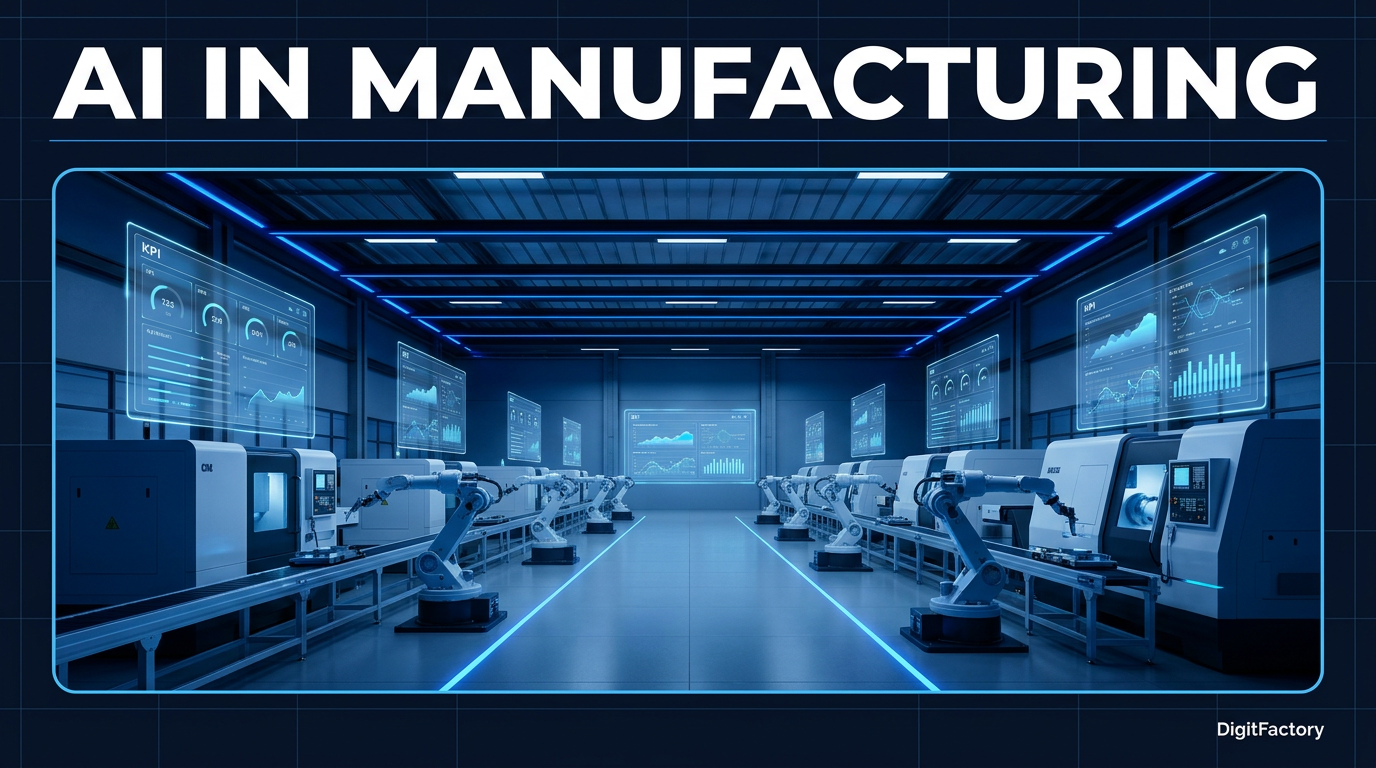
AI in manufacturing is no longer a futuristic promise — it is already transforming the way production companies operate worldwide. For manufacturers across every sector, artificial intelligence unlocks tremendous opportunities: from automated quality control and predictive maintenance to fully connected smart factory operations. As Industry 4.0 accelerates, organizations that embrace AI in manufacturing gain a decisive competitive edge in quality, efficiency, and agility.
This guide is designed for plant managers, production directors, and decision-makers in manufacturing who want to understand what AI in manufacturing means in practice, which application areas deliver the highest ROI, and how to get started — even without an in-house data science team.
Key insight: According to McKinsey, AI in manufacturing can reduce production costs by 10-20%, improve quality by up to 35%, and cut unplanned downtime by 50%. For manufacturers, this means that delaying AI adoption risks falling behind competitors who are already reaping these benefits.
What Is AI in Manufacturing?
Artificial intelligence in manufacturing encompasses the use of self-learning algorithms and data-driven systems that analyze, optimize, and partially autonomously control production processes. Unlike traditional automation, which follows fixed rules, AI learns from data and continuously adapts to changing conditions on the factory floor.
Several forms of AI are being deployed across the manufacturing industry today:
- Machine Vision: AI-powered camera systems detect defects, scratches, cracks, and surface anomalies with an accuracy that far exceeds human inspection. Inspection rates of up to 60 frames per second enable 100% real-time production inspection — eliminating the need for statistical sampling.
- Predictive Analytics: Algorithms analyze sensor data — vibrations, temperatures, power consumption — and identify patterns that indicate impending machine failures. This allows maintenance to be scheduled before an unplanned shutdown occurs.
- Natural Language Processing (NLP): AI systems process unstructured data from maintenance logs, shift reports, and technical documents to uncover hidden correlations and recurring problems that would otherwise go unnoticed.
- Reinforcement Learning: Adaptive control systems autonomously optimize process parameters such as temperature, pressure, and speed to minimize scrap and maximize throughput.
A critical point: AI does not replace workers — it empowers them. Experienced specialists are supported by AI-driven insights to make better and faster decisions, while being freed from repetitive, ergonomically demanding tasks.
Application Areas: Where AI in Manufacturing Delivers the Greatest Value
1. Quality Control and Defect Detection
Visual quality control powered by AI is one of the most mature and economically compelling application areas. AI vision systems, combined with high-performance cameras and edge computing platforms like NVIDIA Jetson, inspect every single product on the production line. Defects as small as 0.25 mm are reliably detected — far beyond what manual inspection can achieve.
Typical results include: defect rate reduction of over 80%, complete traceability through seamless image archiving, and ROI within less than 6 months. For industries where quality is non-negotiable — automotive, pharmaceuticals, electronics — AI-powered inspection is rapidly becoming the standard.
2. Predictive Maintenance
Unplanned machine downtime costs the manufacturing industry billions of dollars every year. AI-powered predictive maintenance continuously analyzes sensor data — vibration patterns, temperature curves, acoustic signatures, and motor current — to detect anomalies weeks before an actual failure occurs. The shift from reactive to predictive maintenance reduces unplanned downtime by 30-50% and significantly lowers maintenance costs while extending equipment lifespan.
3. Process Optimization
AI algorithms analyze hundreds of process parameters simultaneously and find optimal settings that a human engineer could not identify given the complexity of the interdependencies. From energy efficiency and cycle time to material utilization and yield — AI-driven process optimization delivers measurable improvements across the entire value chain. Manufacturing companies report energy savings of 10-15% and throughput increases of up to 20% after implementing AI-based process control.
4. Supply Chain and Production Planning
AI-based demand forecasting and intelligent production scheduling reduce inventory levels, shorten lead times, and improve on-time delivery rates. In volatile markets — which have become the norm since the pandemic disrupted global supply chains — AI provides the agility that traditional planning systems simply cannot deliver. Machine learning models continuously learn from demand signals, supplier performance, and market conditions to keep production aligned with reality.
"The biggest mistake manufacturing companies can make is waiting until AI is perfect. The technology is mature enough for productive use — and the companies that start now are building an advantage that will be hard to catch up with."
Benefits for the Manufacturing Industry
Implementing AI in manufacturing generates measurable benefits on multiple levels:
- ROI acceleration: Most AI projects in manufacturing pay for themselves within 6-18 months. Pilot projects with a tightly defined scope often achieve an ROI exceeding 300%.
- Competitive advantage: Companies that deploy AI produce faster, with less scrap, and with greater flexibility. In a globalized market, this is the decisive differentiator between industry leaders and those struggling to keep up.
- Employee empowerment: AI takes over repetitive and ergonomically demanding inspection tasks. Skilled workers are freed for higher-value activities — from process improvement to creative problem-solving. This boosts job satisfaction and reduces turnover.
- Sustainability: Less scrap, optimized energy consumption, and more efficient resource utilization — AI directly contributes to sustainability goals that are becoming increasingly important both for regulatory compliance and customer expectations.
- Scalability: A successful AI pilot can be scaled to additional production lines, plants, and use cases. The initial effort decreases significantly with each subsequent rollout, creating a compounding return on the original investment.
Real-world results: Manufacturing companies using AI for quality control report defect reduction of over 80%, inspection time reduction of 90%, and ROI in less than 6 months.
Challenges and Solutions
The path to AI-powered manufacturing is not without hurdles. The good news: for every challenge, there are proven solutions.
Data Quality and Availability
Challenge: AI needs data — and many manufacturing companies have machines with sensors but no structured data foundation. Legacy systems often do not provide machine-readable data formats.
Solution: Start with a focused pilot project on a single production line. Modern edge AI systems can connect directly to existing PLC/SCADA infrastructure and begin data collection immediately. Often, just 2-4 weeks of training data is enough to produce initial results.
Integration with Existing Systems
Challenge: Manufacturing companies often operate heterogeneous system landscapes with machines from different vendors and generations.
Solution: Open interfaces and industrial standards like OPC UA enable the integration of AI systems into existing infrastructures. Edge computing solutions process data directly on-site without requiring cloud connectivity — a critical advantage for data sovereignty, security, and latency requirements.
Skills Gap
Challenge: AI expertise is expensive and hard to find — especially for small and mid-sized manufacturers.
Solution: Specialized AI partners like DigitFactory bring the technical know-how and work closely with your existing production team. Knowledge transfer is part of every implementation, ensuring your internal team can maintain and evolve the solution long-term.
Change Management
Challenge: Employees fear being replaced by AI. Resistance to new technology can derail projects before they deliver value.
Solution: Transparent communication and employee involvement from the start. AI systems should be positioned as tools that help workers — not replace them. Training programs and visible quick wins build acceptance and enthusiasm across the organization.
AI and Industry 4.0: The Connected Factory of the Future
AI is one of the key technologies within the Industry 4.0 framework. It reaches its full potential when combined with complementary technologies:
- IoT + AI: Connected sensors (IIoT) provide the data foundation that AI algorithms need for analysis and prediction. Every machine becomes a data source, every sensor becomes an early warning system.
- Digital Twin + AI: Digital twins — virtual replicas of physical production assets — allow process changes and optimizations to be tested in simulation before being deployed in real production. AI accelerates the simulation and identifies optimal configurations in a fraction of the time a human engineer would need.
- Edge Computing + AI: Processing AI models directly at the machine (edge) enables response times in the millisecond range — critical for real-time quality control and autonomous process adjustments. Platforms like NVIDIA Jetson make industrial-grade edge AI affordable and straightforward to deploy.
- Robotics + AI: AI-powered robots and cobots adapt flexibly to changing tasks and products without complex reprogramming — a key enabler for the economical production of small batch sizes and high-mix manufacturing.
The smart factory emerges through the orchestration of all these technologies. AI is the connecting element that transforms isolated data points into actionable insights and autonomous actions across the entire production ecosystem.
Getting Started: How to Successfully Launch AI in Manufacturing
A successful start with AI follows a proven pattern — regardless of company size or industry:
- Identify the pain point: Start where the pressure is greatest. High scrap rates? Unplanned downtime? Quality issues reaching customers? A clearly defined problem is the best starting point — and the fastest path to demonstrable ROI.
- Run a quick pilot (4-8 weeks): Launch a focused pilot project on a single production line or machine. The goal is to prove the value of the AI solution quickly and measurably, with minimal disruption to existing operations.
- KPI-based evaluation: Define clear success metrics upfront — e.g., defect reduction in %, reduction of unplanned downtime, savings in material consumption. Only what is measured can be improved, and clear KPIs make the business case undeniable.
- Choose the right partner: Select an AI partner that combines AI expertise with deep understanding of industrial automation. The combination of IT and OT (Operational Technology) competence is critical for bridging the gap between lab demos and factory-floor reality.
- Scale systematically: After a successful pilot, scale the solution step by step to additional lines and use cases. Each iteration becomes faster and more cost-effective than the previous one, as models improve and organizational knowledge grows.
"The best time to adopt AI in manufacturing was five years ago. The second best time is now. A quick pilot project demonstrates in just a few weeks what concrete value AI delivers for your production."
DigitFactory: Your AI Partner for Manufacturing
DigitFactory unites two worlds that are critical for successful AI implementation: deep understanding of industrial automation (PLC/SCADA, 8+ years of experience) and cutting-edge AI technology. This combination is rare — and it makes the difference between a proof-of-concept that collects dust and a solution that works in real production environments, delivering measurable results from day one.
The DigitFactory offering for AI in manufacturing includes:
- AI Vision for Quality Control: Defect detection down to 0.25 mm, 60 FPS real-time inspection, complete image archiving, and full traceability for every product.
- Predictive Maintenance: Vibration analysis, temperature monitoring, and Motor Current Signature Analysis (MCSA) for predicting machine failures before they happen.
- Edge AI Deployment: NVIDIA Jetson-based solutions that operate directly at the machine — no cloud dependency, full data sovereignty, millisecond response times.
- Seamless Integration: Bidirectional communication with existing PLC/SCADA systems. OK/NOK signals, OPC UA connectivity, and comprehensive data archiving.
Success-fee model: DigitFactory operates on a "pay for results" principle. Full payment is made only after achieving the agreed KPIs. This minimizes your risk and demonstrates our confidence in the effectiveness of our solutions.
Summary
AI in manufacturing is the decisive lever for making the manufacturing industry future-proof. The technology is mature, the use cases are proven, and the ROI is measurable. Whether quality control, predictive maintenance, or process optimization — AI delivers demonstrable results in every one of these areas.
The key to success lies not in a massive transformation project, but in the focused pilot approach: a clearly defined problem, a quick proof-of-value, and a partner who understands both AI and the reality on the shop floor.
The smart factory is no longer a vision — it is the logical next step for manufacturers who want to stay competitive. And getting started is easier than most people think.
Ready to take the first step? Discover DigitFactory ONE — our AI platform built specifically for the manufacturing industry.