AI Maintenance Copilot: How Generative AI Transforms Industrial Maintenance
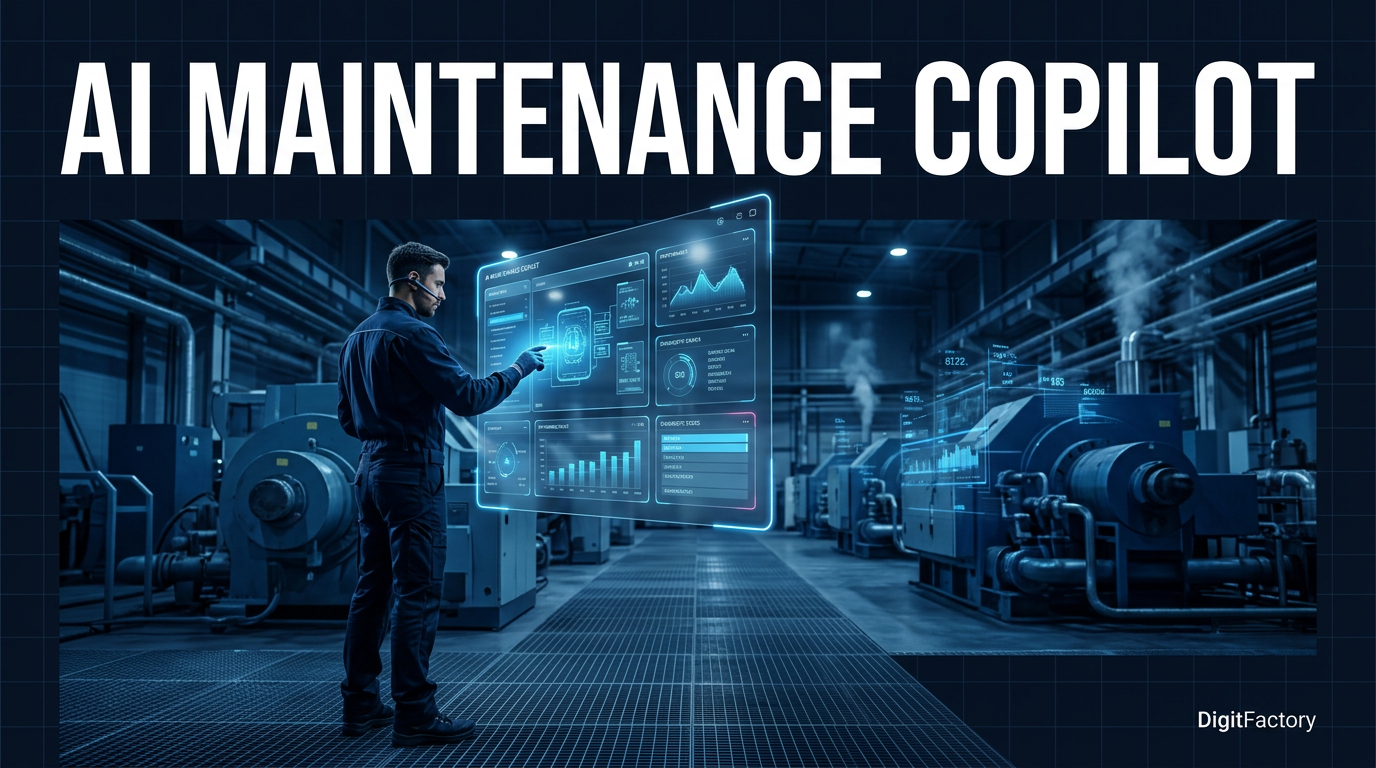
Industrial maintenance is undergoing its most significant transformation in decades. While predictive maintenance and IoT sensors have been reshaping how factories monitor equipment, a new category of tool is emerging that changes how maintenance teams work with information: the AI maintenance copilot. Powered by large language models (LLMs) and generative AI, these intelligent assistants give technicians a conversational interface to decades of equipment data, maintenance procedures, and institutional knowledge that was previously locked away in manuals, spreadsheets, and the heads of senior engineers.
The maintenance industry faces a well-documented crisis. Experienced technicians are retiring faster than new ones can be trained. The average age of a skilled maintenance worker in manufacturing continues to rise, and with each retirement, critical knowledge about specific machines, failure patterns, and proven repair techniques walks out the door. At the same time, modern production equipment is becoming more complex, integrating PLCs, SCADA systems, variable frequency drives, and networked sensors that require a breadth of expertise no single technician can master alone.
This is exactly where generative AI steps in -- not to replace human expertise, but to augment it. An AI maintenance copilot acts as an always-available, infinitely patient assistant that helps every technician perform like a veteran.
Key insight: An AI maintenance copilot does not replace technicians. It amplifies their capabilities by giving them instant access to the collective knowledge of the entire maintenance organization -- past work orders, equipment manuals, failure histories, and proven repair procedures -- through a simple conversational interface.
What Is an AI Maintenance Copilot?
An AI maintenance copilot is a conversational AI assistant specifically designed for industrial maintenance operations. Unlike generic chatbots, it is deeply integrated with plant-specific data: equipment registries, maintenance histories, spare parts inventories, OEM documentation, standard operating procedures, and real-time sensor feeds. Technicians interact with it using natural language -- either by typing or speaking -- and receive contextually relevant answers grounded in their facility's actual data.
Think of it as having a conversation with the most knowledgeable maintenance engineer in your plant, one who has perfect recall of every work order ever filed, every equipment manual ever written, and every troubleshooting procedure ever documented. That engineer never sleeps, never forgets, and is available to every member of the team simultaneously.
Typical interactions with an AI maintenance copilot include:
- "What are the most common failure modes for pump P-2401?" -- The copilot searches maintenance history and returns a ranked list of past failures with frequencies, root causes, and resolution steps.
- "Generate a work order for replacing the bearing on conveyor C-12." -- The copilot creates a structured work order with the correct parts, tools, safety procedures, and estimated time based on historical data.
- "The VFD on line 3 is showing fault code F-47. What should I check?" -- The copilot cross-references the fault code with the drive's manual, past incidents, and known remediation steps.
Key Capabilities of an AI Maintenance Copilot
A well-implemented AI maintenance copilot delivers value across five core areas that directly address the daily challenges of maintenance teams:
1. Intelligent Troubleshooting Guidance
When a machine goes down, every minute counts. An AI copilot dramatically reduces time-to-diagnosis by correlating the current symptoms with historical failure data, OEM documentation, and similar incidents across the plant. Instead of flipping through a 500-page manual or calling a colleague who may or may not remember the fix, the technician asks the copilot and gets a prioritized list of likely causes with step-by-step resolution procedures.
2. Automatic Work Order Generation
Creating detailed, accurate work orders is one of the most time-consuming administrative tasks in maintenance. An AI copilot can generate complete work orders from a brief voice or text description. It automatically populates the correct asset ID, required spare parts (checked against inventory), safety lockout/tagout procedures, estimated labor hours, and priority level -- all based on the context of the request and historical patterns.
3. Knowledge Base Search and Synthesis
Maintenance knowledge is typically scattered across CMMS databases, PDF manuals, engineering drawings, tribal knowledge, and email threads. The AI copilot serves as a unified search interface that can retrieve and synthesize information from all these sources. Instead of returning a list of documents, it provides direct, synthesized answers with citations to the source material.
4. Training and Onboarding Assistance
New technicians can use the AI copilot as an interactive training companion. They can ask questions about unfamiliar equipment, request explanations of procedures at different levels of detail, and walk through troubleshooting scenarios in a safe, conversational format. This significantly accelerates onboarding and reduces the burden on senior staff who would otherwise need to mentor newcomers full-time.
5. Report Generation and Analysis
The copilot can generate maintenance reports on demand -- MTBF (Mean Time Between Failures) analyses, cost summaries, reliability trends, and compliance documentation. Managers can ask questions like "What were our top 5 sources of unplanned downtime last quarter?" and receive formatted reports with charts and actionable insights, without needing to export data and build spreadsheets manually.
"The best maintenance copilot is one that makes every technician on the team as effective as your most experienced engineer -- not by replacing judgment, but by ensuring the right information is always at their fingertips."
How It Works: LLM + RAG + Equipment Data
The technology behind an AI maintenance copilot combines three key components:
- Large Language Model (LLM): The core AI engine that understands natural language, reasons about context, and generates human-quality responses. Models like GPT-4, Claude, or purpose-trained industrial LLMs provide the conversational intelligence.
- Retrieval Augmented Generation (RAG): Rather than relying solely on the LLM's training data, RAG connects the model to your plant's specific knowledge base. When a technician asks a question, the system first retrieves relevant documents, work orders, and equipment data, then uses the LLM to synthesize a contextual answer. This ensures responses are grounded in your actual data, not generic information.
- Equipment Data Integration: The copilot connects to your CMMS, historian databases, real-time sensor feeds (vibration, temperature, current), PLC/SCADA systems, and spare parts inventory. This live data connection means the copilot's answers reflect the current state of your equipment, not just historical records.
The RAG architecture is particularly important for industrial applications. It solves the hallucination problem that plagues generic AI chatbots by anchoring every response in verifiable source data. When the copilot tells a technician to check a specific bearing, it can cite the exact work order, manual page, or sensor reading that supports that recommendation.
Benefits: Why Maintenance Teams Adopt AI Copilots
Organizations implementing AI maintenance copilots report measurable improvements across several key metrics:
- 40-60% reduction in time-to-diagnosis: Technicians find root causes faster when they can instantly query historical failure data and equipment documentation.
- Standardized procedures across shifts: The copilot ensures every technician follows the same best-practice procedures, regardless of experience level or shift.
- Institutional knowledge preservation: When senior technicians retire, their knowledge lives on in the system through documented work orders, troubleshooting notes, and procedures that the copilot can retrieve and present to new team members.
- 50% faster onboarding: New hires become productive sooner because they have an always-available knowledge resource that answers questions without requiring senior staff time.
- 30% reduction in administrative time: Automated work order generation, report creation, and documentation eliminate hours of paperwork per technician per week.
AI Copilot vs Traditional CMMS
A traditional CMMS (Computerized Maintenance Management System) is form-based, menu-driven, and requires users to know exactly where to find information. An AI copilot transforms this interaction model fundamentally:
- Conversational vs form-based: Instead of navigating through menus and filling out forms, technicians simply describe what they need in plain language. The copilot handles the data retrieval and entry.
- Proactive vs reactive information: A traditional CMMS waits for queries. An AI copilot can proactively surface relevant information -- alerting a technician that the pump they are about to service had a similar issue last year with a specific root cause, or that the spare part they need is running low in inventory.
- Synthesized vs raw data: CMMS returns records and lists. The copilot synthesizes information from multiple sources into actionable guidance. Instead of 47 past work orders to read through, you get a summary of patterns and recommended actions.
- Accessible to all skill levels: Traditional CMMS systems have steep learning curves. A conversational AI copilot is immediately intuitive -- if you can describe your problem in words, you can use the system effectively.
Importantly, an AI copilot does not replace the CMMS -- it sits on top of it, making the existing data more accessible and actionable. Your CMMS remains the system of record; the copilot becomes the intelligent interface layer.
DigitFactory AI Assistant: Your Maintenance Copilot
DigitFactory ONE includes an integrated AI maintenance copilot purpose-built for manufacturing environments. Unlike generic AI tools adapted for industrial use, the DigitFactory AI Assistant is designed from the ground up for maintenance teams working with real production equipment.
Key features of the DigitFactory AI Assistant:
- Deep PLC/SCADA integration: Connects directly to Siemens, Allen-Bradley, and other industrial control systems to provide real-time equipment context.
- RAG-powered knowledge base: Indexes your equipment manuals, maintenance procedures, work order history, and tribal knowledge into a searchable, conversational interface.
- Voice-first design: Technicians can interact hands-free on the factory floor using voice commands -- essential when working inside a machine or wearing gloves.
- Multilingual support: Operates in Polish, English, German, and Czech -- critical for diverse manufacturing workforces across Central Europe.
- Edge deployment: Runs on-premises with NVIDIA Jetson hardware, ensuring data stays within your facility and the system works even without internet connectivity.
See DigitFactory ONE in action: The AI Assistant module is part of the DigitFactory ONE platform for manufacturing intelligence. Learn more about DigitFactory ONE and discover how an AI maintenance copilot can transform your maintenance operations.
Summary
The AI maintenance copilot represents a fundamental shift in how maintenance teams interact with information. By combining the conversational power of large language models with RAG-based access to plant-specific data, these tools make every technician more effective, preserve institutional knowledge, and dramatically reduce the time spent on diagnosis, documentation, and administrative tasks.
As manufacturing equipment grows more complex and the experienced workforce continues to shrink, AI copilots are not a luxury -- they are becoming a necessity. The question for maintenance leaders is no longer whether to adopt generative AI, but how quickly they can deploy it to capture the knowledge of today's experts before it walks out the door.
The future of industrial maintenance is conversational, contextual, and AI-augmented. Companies that embrace this shift now will build a lasting competitive advantage in operational excellence.
References
- McKinsey & Company. Generative AI in manufacturing operations. Available at: https://www.mckinsey.com/capabilities/operations/our-insights/the-next-frontier-of-generative-ai-in-manufacturing
- Deloitte. Smart factory and Industry 4.0: Predictive maintenance. Available at: https://www2.deloitte.com/us/en/insights/focus/industry-4-0/using-predictive-technologies-for-asset-maintenance.html
- NVIDIA. Industrial AI with retrieval augmented generation. Available at: https://developer.nvidia.com/blog/build-enterprise-retrieval-augmented-generation-apps-with-nvidia-retrieval-qa-embedding-model/