AI-Powered CMMS: The Future of Maintenance Management in Manufacturing
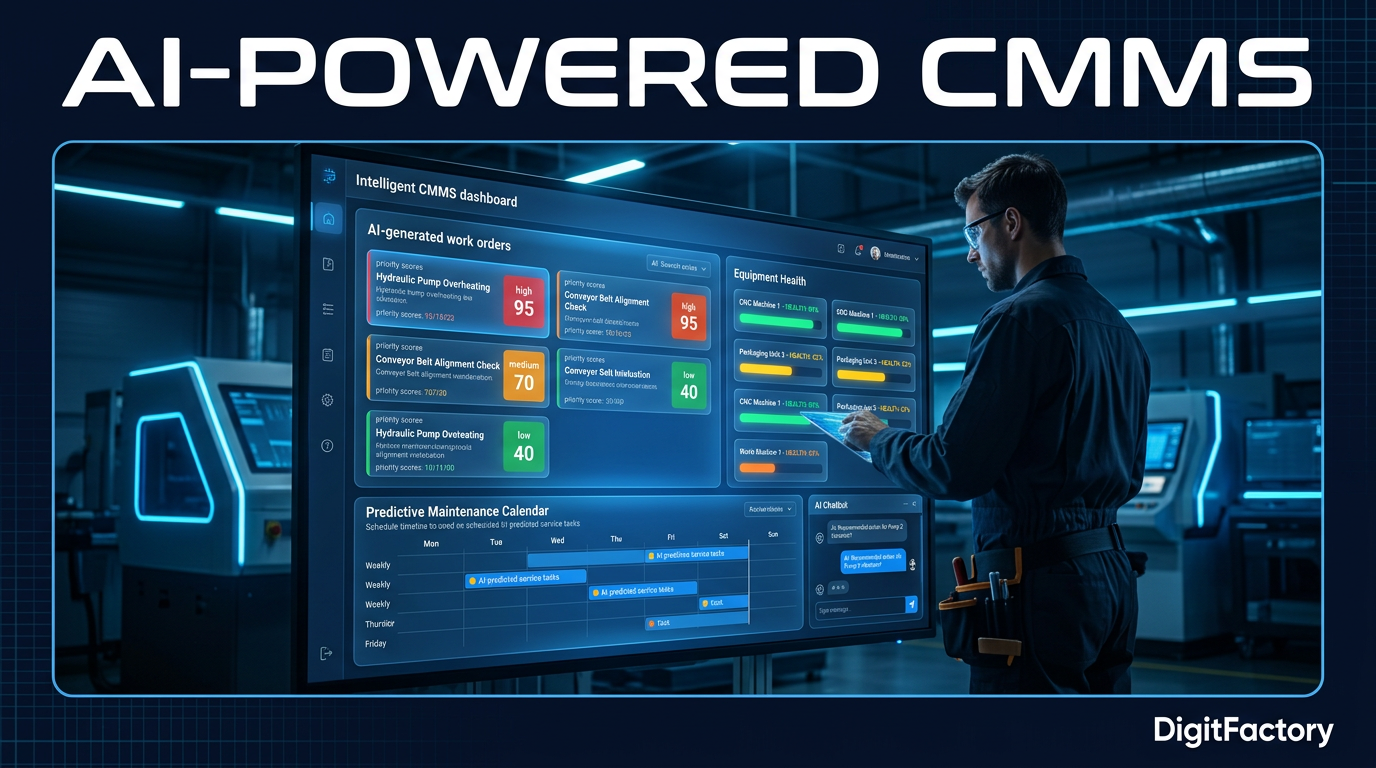
Maintenance management has come a long way — from paper logbooks and clipboard checklists to spreadsheets and computerized systems. Today, AI CMMS software represents the next leap forward: a maintenance management system that doesn't just record what happened, but actively predicts what will happen and recommends what to do about it.
For decades, CMMS platforms have served as the digital backbone of maintenance operations, enabling teams to schedule preventive maintenance, manage work orders, and track spare parts inventories. But even the most sophisticated traditional CMMS is reactive by design — it organizes activities but cannot anticipate equipment failures or optimize resources based on real-time conditions.
An AI-powered CMMS changes this equation. By learning from historical data, ingesting real-time sensor readings, and continuously refining its understanding of equipment behavior, it moves maintenance from scheduled routines to intelligent, condition-based decision-making.
What is AI-Powered CMMS?
An AI-powered CMMS is a maintenance management platform enhanced with machine learning algorithms, natural language processing, and predictive analytics. While a traditional CMMS acts as a database and workflow engine — storing asset records, scheduling preventive tasks on fixed intervals, and tracking work order completion — an AI CMMS adds a layer of intelligence that transforms how maintenance decisions are made.
At its core, CMMS AI capabilities work by continuously analyzing data from multiple sources: vibration sensors, temperature probes, current monitors, oil analysis results, historical failure records, and technician notes. Machine learning models identify patterns that precede equipment failures, often weeks before a breakdown would occur. Natural language processing enables technicians to interact with the system conversationally, asking questions like "What's the failure risk for Pump 7 this week?" and receiving actionable answers.
"The difference between traditional CMMS and AI CMMS is the difference between a calendar and an advisor. One tells you when maintenance is scheduled. The other tells you when maintenance is actually needed — and what will happen if you delay it."
This intelligence layer doesn't replace the proven foundations of CMMS — asset management, work order tracking, inventory control — it amplifies them. Every function becomes smarter, more responsive, and more aligned with the actual condition of equipment on the factory floor.
Key Features of AI CMMS Software
The capabilities that set intelligent maintenance management apart from traditional systems span the entire maintenance workflow, from failure prediction to post-repair analysis.
Core AI CMMS Capabilities:
- Automated Work Order Generation — AI triggers work orders based on detected anomalies, not calendar schedules
- AI-Driven Priority Scoring — each work order is ranked by failure probability, production impact, and safety risk
- Spare Parts Optimization — ML models predict parts consumption and recommend optimal stock levels
- AI Maintenance Assistant — natural language interface for technicians to query asset health and get repair guidance
- Root Cause Analysis — automatic correlation of failure patterns across similar assets
Automated Work Order Generation
Traditional CMMS generates work orders on fixed time intervals: inspect Motor A every 30 days, replace Belt B every 6 months. A predictive CMMS generates work orders when they are actually needed. If vibration analysis shows that Motor A's bearings are degrading faster than expected, the system creates a work order immediately — even if the scheduled inspection is three weeks away. Conversely, if Belt B shows no signs of wear at the 6-month mark, the system extends the interval rather than wasting resources on unnecessary replacement.
AI-Driven Priority Scoring
Not all maintenance tasks carry equal urgency. AI CMMS software evaluates each work order against multiple factors: the probability of failure within the next shift, the production line's criticality, safety implications, available spare parts, and technician availability. The result is a dynamically ranked backlog where the most impactful tasks always surface first.
Spare Parts Optimization
Spare parts inventory is one of the largest hidden costs in maintenance operations. Too much stock ties up capital; too little causes extended downtime when a critical part is unavailable. AI analyzes consumption patterns, lead times, failure probabilities, and vendor reliability to recommend optimal reorder points and quantities. The system learns from every parts request, continuously improving its forecasts.
AI Assistant for Maintenance Teams
An AI-powered maintenance assistant gives technicians instant access to the collective knowledge of the organization. Instead of searching through manuals or calling senior colleagues, a technician can ask the system for troubleshooting guidance, historical repair data for a specific asset, or the most likely root cause of a symptom. The assistant learns from every interaction, building an ever-expanding knowledge base.
Traditional CMMS vs AI CMMS
The gap between conventional and AI-powered CMMS is not incremental — it represents a fundamentally different approach to maintenance.
- Scheduling: Calendar-based fixed intervals vs. condition-based predictive scheduling that triggers maintenance precisely when data indicates it is needed — eliminating both over-maintenance and unexpected failures.
- Data entry: Manual logging of readings and notes vs. auto-capture from IoT sensors and image recognition — no more clipboards on the shop floor.
- Decision-making: Raw data for human interpretation vs. AI-generated recommendations backed by probability scores, historical precedent, and impact analysis.
- Knowledge retention: Institutional knowledge lost when experienced technicians retire vs. expertise captured in AI models, preserved and scaled across the entire team.
Integration with Predictive Maintenance
The true power of AI CMMS software emerges when it integrates with predictive maintenance (PdM). Individually, each delivers value. Together, they create a complete maintenance intelligence platform.
PdM systems analyze sensor data — vibration, temperature, acoustic emissions, electrical signatures — to detect early equipment degradation. But without a CMMS, alerts exist in isolation with no workflow to assign technicians, check parts, or schedule repairs around production.
An AI CMMS bridges this gap. When PdM detects a developing gearbox fault, the CMMS automatically creates a prioritized work order, verifies spare parts availability, identifies the best-qualified technician, and suggests an optimal repair window. The entire chain — from anomaly detection to completed repair — is orchestrated intelligently.
"Predictive maintenance tells you something is going wrong. AI CMMS tells you exactly what to do about it, who should do it, and when — all before the equipment actually fails."
ROI and Business Impact
The business case for intelligent maintenance management is compelling and well-documented across manufacturing industries.
- 20-30% reduction in total maintenance costs — by eliminating unnecessary preventive tasks and catching failures before they cause cascading damage, AI CMMS significantly reduces both labor and material costs.
- Up to 45% less unplanned downtime — predictive work order generation means equipment is repaired before it fails, keeping production lines running. In manufacturing, where a single hour of downtime can cost tens of thousands of dollars, this impact is substantial.
- Optimized spare parts inventory — AI-driven demand forecasting typically reduces spare parts carrying costs by 15-25% while simultaneously improving parts availability when needed.
- Extended asset lifespan — condition-based maintenance ensures equipment is serviced at the optimal moment — not too early (wasting parts life) and not too late (causing secondary damage). This can extend asset useful life by 20-40%.
- Improved safety and compliance — automated documentation, audit trails, and proactive hazard identification help manufacturing plants meet ISO 55000, OSHA, and industry-specific regulatory requirements.
Measurable Impact: Manufacturing plants implementing AI CMMS report an average ROI payback period of 6-12 months, with total maintenance cost reductions of 20-30% and unplanned downtime decreases of up to 45%.
DigitFactory ONE: CMMS as Part of a Complete Platform
Many organizations implement CMMS, predictive maintenance, and quality control as separate, siloed systems. DigitFactory ONE takes a different approach — integrating all three into a unified AI platform built for manufacturing.
The CMMS module is natively connected to DigitFactory ONE's AI Predictive engine and AI Vision quality control. When PdM detects abnormal vibration in a CNC spindle, the CMMS generates a prioritized work order. When AI Vision identifies rising defect rates, the CMMS correlates this with equipment health data to determine whether adjustment or replacement is needed.
This creates a feedback loop that standalone systems cannot achieve. Maintenance actions are informed by quality data, quality trends are explained by equipment condition, and production schedules are optimized with full visibility into both. The result is maintenance that is not just predictive, but truly intelligent — understanding the process holistically rather than managing equipment in isolation.
Built on years of experience in industrial automation (PLC/SCADA) and cutting-edge AI, DigitFactory ONE bridges operational technology and modern artificial intelligence — delivering practical results on real factory floors.
Summary
The evolution from paper logs to AI-powered CMMS is more than a technology upgrade — it is a fundamental shift in how manufacturers approach maintenance. Traditional CMMS digitized workflows. AI CMMS software makes them intelligent, predictive, and continuously improving.
For manufacturers under pressure to reduce costs, increase uptime, and extend asset life, AI-powered CMMS is no longer a future vision — it is a proven solution delivering measurable ROI today. Organizations that adopt intelligent maintenance management now will build a significant competitive advantage as the industry transforms toward Industry 4.0.
Ready to transform your maintenance operations? Discover how DigitFactory ONE integrates AI CMMS with predictive maintenance and AI vision into a single platform built for manufacturing. Learn more about DigitFactory ONE.