Edge AI in Manufacturing: Real-Time Intelligence on the Factory Floor
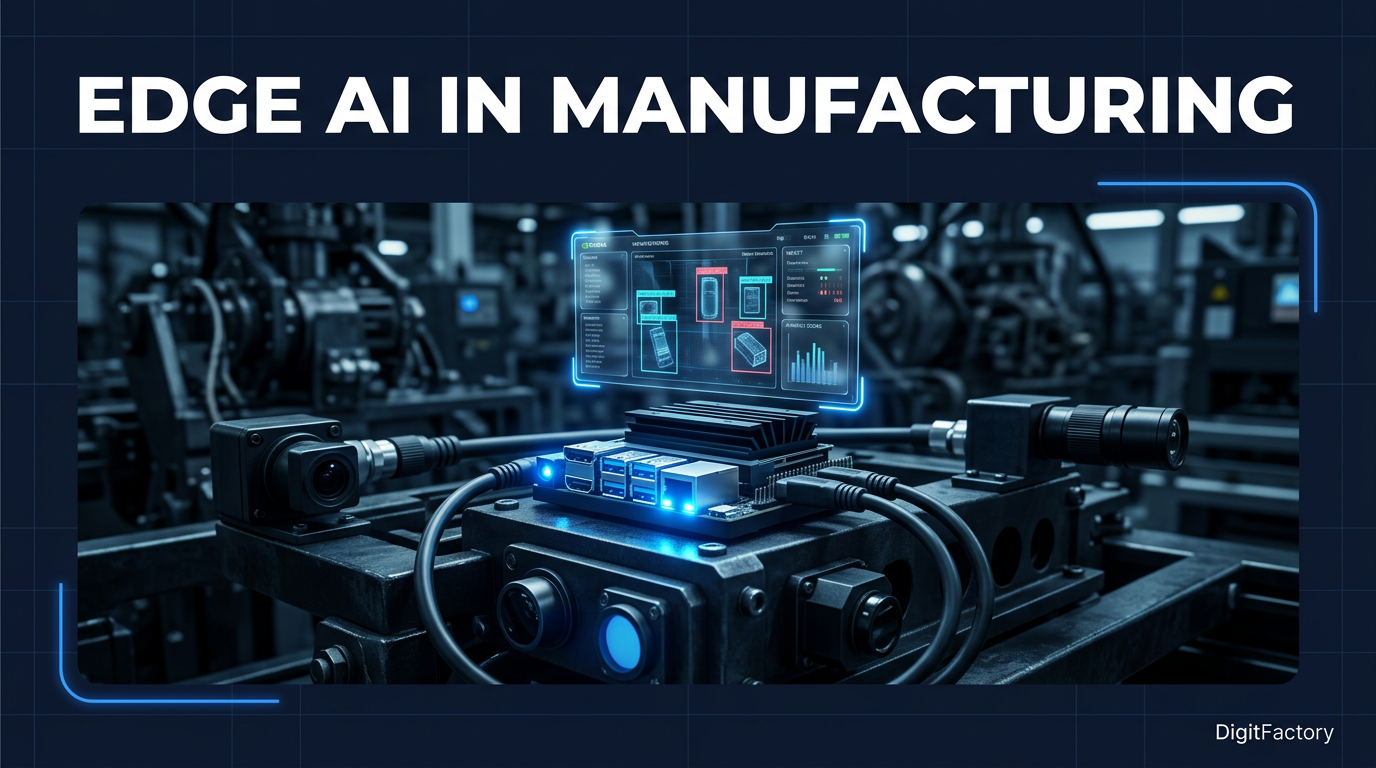
Manufacturing is entering a new era. As factories generate terabytes of sensor data every day, the traditional approach of shipping everything to the cloud for analysis is hitting hard limits. Network latency measured in hundreds of milliseconds is too slow when a stamping press cycles every 200 ms. Uploading gigabytes of high-resolution camera feeds to a remote data center saturates bandwidth and inflates costs. And in regulated industries, sending production data off-premises raises serious data-sovereignty concerns.
Edge AI solves these problems by bringing artificial intelligence directly to the factory floor. Instead of relying on a distant cloud server, inference runs on compact, ruggedized hardware installed next to the production line. The result is sub-millisecond decision-making, complete data privacy, and systems that keep running even when the internet connection goes down.
DigitFactory specializes in deploying edge AI solutions for manufacturing. With deep expertise in PLC/SCADA automation and modern AI frameworks, we bridge the gap between operational technology and cutting-edge machine learning, delivering real-time intelligence that integrates seamlessly with existing production infrastructure.
What is Edge AI?
Edge AI refers to running artificial intelligence algorithms locally on a hardware device at the "edge" of the network, close to the data source, rather than in a centralized cloud or on-premises data center. In a manufacturing context, the "edge" is the machine, the production line, or the factory hall itself.
The key distinction between edge AI and cloud AI lies in where inference happens:
- Cloud AI: Sensor data is collected, transmitted over a network to a remote server, processed, and the result is sent back. This round trip introduces latency (typically 50-500 ms), depends on a stable internet connection, and requires transferring potentially sensitive data outside the factory.
- Edge AI: A trained model is deployed onto a local device that performs inference on-site. Latency drops to single-digit milliseconds or less, no external connectivity is required during operation, and raw data never leaves the premises.
The NVIDIA Jetson Platform
The hardware backbone of modern industrial edge AI is the NVIDIA Jetson family of embedded computing modules. Ranging from the entry-level Jetson Orin Nano (up to 40 TOPS of AI performance) to the Jetson AGX Orin (275 TOPS), these modules pack GPU-accelerated computing into compact, fanless, industrial-temperature-rated packages that consume as little as 7-15 watts.
Jetson modules run the full NVIDIA AI software stack, including TensorRT for optimized inference, DeepStream for video analytics pipelines, and Isaac ROS for robotics applications. This means models trained in the cloud using frameworks like PyTorch or TensorFlow can be optimized and deployed to the edge with minimal re-engineering.
Applications in Manufacturing
Edge AI unlocks a range of use cases that are impractical or impossible with cloud-only architectures. Here are the three most impactful applications on the factory floor.
1. Real-Time Defect Detection
High-speed production lines demand inspection at every cycle. A vision system powered by edge AI can analyze camera frames in under 10 milliseconds, detecting surface scratches, dimensional deviations, color inconsistencies, or missing components before a defective part moves to the next station. Because the model runs locally, the system delivers an OK/NOK signal to the PLC within the same machine cycle, enabling automatic rejection without slowing the line.
DigitFactory's AI Vision modules achieve detection accuracy above 99.5% at speeds of up to 60 frames per second, running entirely on NVIDIA Jetson hardware with no cloud dependency.
2. Predictive Maintenance
Vibration sensors, current monitors, and temperature probes generate continuous streams of time-series data. An edge AI model trained on normal operating patterns can detect anomalies, such as a bearing beginning to degrade or a motor drawing abnormal current, and issue early warnings days or weeks before a breakdown occurs. By processing data locally, the system can monitor hundreds of sensors simultaneously without the bandwidth cost of streaming raw waveforms to the cloud.
3. Safety Monitoring
Edge-deployed computer vision models can monitor for safety violations in real time: workers entering restricted zones without PPE, forklifts operating too close to pedestrians, or emergency exits being blocked. Because these detections happen locally with sub-second latency, the system can trigger immediate alerts or even automated shutdowns, preventing incidents rather than just documenting them after the fact.
Benefits Over Cloud-Only AI
While cloud computing remains essential for model training, data aggregation, and enterprise analytics, running inference at the edge provides decisive advantages in a manufacturing environment.
Sub-Millisecond Latency
Edge inference eliminates network round-trip time entirely. For a vision-based quality inspection system, this means the go/no-go decision arrives within the same PLC scan cycle (typically 2-10 ms), enabling closed-loop control that is simply not achievable with cloud inference.
Data Sovereignty and Privacy
Raw production images, sensor data, and process parameters never leave the factory. This is critical for manufacturers bound by GDPR, industry-specific regulations, or customer NDAs that restrict data transfer. Only aggregated analytics and model performance metrics need to be shared externally.
Offline Operation
Edge AI systems are self-contained. A network outage, ISP failure, or planned maintenance window does not interrupt production or disable quality controls. The factory keeps its AI capabilities running 24/7, regardless of connectivity status.
Lower Total Cost of Ownership
Streaming high-resolution video or high-frequency sensor data to the cloud generates substantial bandwidth and compute costs. An NVIDIA Jetson Orin module, consuming 15-60 watts, performs the same inference workload at a fraction of the ongoing operational cost. For a multi-line factory, the savings compound quickly.
"The factory of the future does not send its data to the cloud and wait for answers. It thinks at the machine, acts in milliseconds, and only shares insights upward. Edge AI makes this possible today."
Edge AI Architecture
A well-designed edge AI deployment in manufacturing follows a layered architecture that integrates with existing automation systems rather than replacing them.
- Sensor Layer: Industrial cameras (area scan, line scan, 3D), vibration sensors, current transformers, temperature probes, and other instrumentation capture raw data from the process.
- Edge Device: An NVIDIA Jetson module (or equivalent edge GPU) receives the raw data over GigE Vision, USB3, or industrial Ethernet. Pre-trained AI models perform inference locally, producing structured results such as defect classifications, anomaly scores, or object detections.
- Local Inference and Decision: The edge device translates AI outputs into actionable signals. For example, a defect detection result becomes an OK/NOK digital output; a predictive maintenance anomaly score triggers a warning threshold in the SCADA historian.
- PLC/SCADA Integration: Results are communicated to the existing automation layer via industrial protocols such as OPC UA, Modbus TCP, or Profinet. The PLC executes the physical response (reject part, stop line, trigger alarm), while SCADA logs events and presents dashboards to operators.
- Cloud Sync (Optional): Aggregated metrics, model performance data, and flagged edge cases are periodically synced to a cloud or on-premises server for model retraining, fleet management, and enterprise-level analytics. Raw data stays on the edge.
This architecture preserves the reliability and determinism of traditional PLC-based control while adding an intelligent perception layer that was previously impossible without cloud infrastructure.
Getting Started with Edge AI
Adopting edge AI does not require ripping out existing systems or committing to a massive capital project upfront. The most successful deployments follow a pragmatic, phased approach.
Start with a Focused Pilot
Choose one production line and one well-defined problem, such as detecting a specific defect type or monitoring a critical asset. A focused pilot can be deployed in weeks, not months, and delivers measurable ROI that justifies broader rollout.
Select the Right Hardware
Match the edge device to the workload. A single-camera defect detection station may need only a Jetson Orin Nano, while a multi-camera, multi-model deployment on a complex line may require a Jetson AGX Orin. Consider environmental factors: operating temperature range, vibration, dust, and enclosure requirements (IP ratings).
Optimize Models for the Edge
Models trained in the cloud with full-precision floating point need to be optimized for edge deployment. Techniques like quantization (FP32 to INT8), pruning, and TensorRT compilation can reduce model size by 4x and increase inference speed by 2-5x with minimal accuracy loss. DigitFactory handles this optimization as part of every deployment.
Plan for Model Lifecycle Management
Production conditions change: new product variants, different materials, seasonal lighting variations. Plan for over-the-air model updates so that edge devices can receive improved models without physical intervention. Track model performance metrics centrally to detect drift early.
Summary
Edge AI is not a future technology. It is a practical, deployable solution that addresses the fundamental constraints of cloud-based AI in manufacturing: latency, bandwidth, data privacy, and reliability. By running inference on ruggedized hardware like NVIDIA Jetson directly on the factory floor, manufacturers gain real-time defect detection, predictive maintenance, and safety monitoring that works independently of cloud connectivity.
The architecture is designed to complement, not replace, existing PLC/SCADA systems. A well-executed pilot on a single line can deliver measurable results in weeks and serve as the foundation for factory-wide intelligent automation.
Ready to bring AI to your factory floor? DigitFactory ONE is our edge AI platform purpose-built for manufacturing. It combines NVIDIA Jetson hardware, optimized AI models, and seamless PLC/SCADA integration into a turnkey solution. Contact us to discuss a pilot on your production line.
References
- NVIDIA Jetson Orin Modules and Developer Kits. NVIDIA. Available at: https://www.nvidia.com/en-us/autonomous-machines/embedded-systems/
- What is Edge AI? NVIDIA Blog. Available at: https://blogs.nvidia.com/blog/what-is-edge-ai/
- Edge Computing in Manufacturing. Deloitte Insights. Available at: https://www2.deloitte.com/us/en/insights/industry/manufacturing/edge-computing-in-manufacturing.html