AI in Automotive Quality Control: Machine Vision for Zero Defect Manufacturing
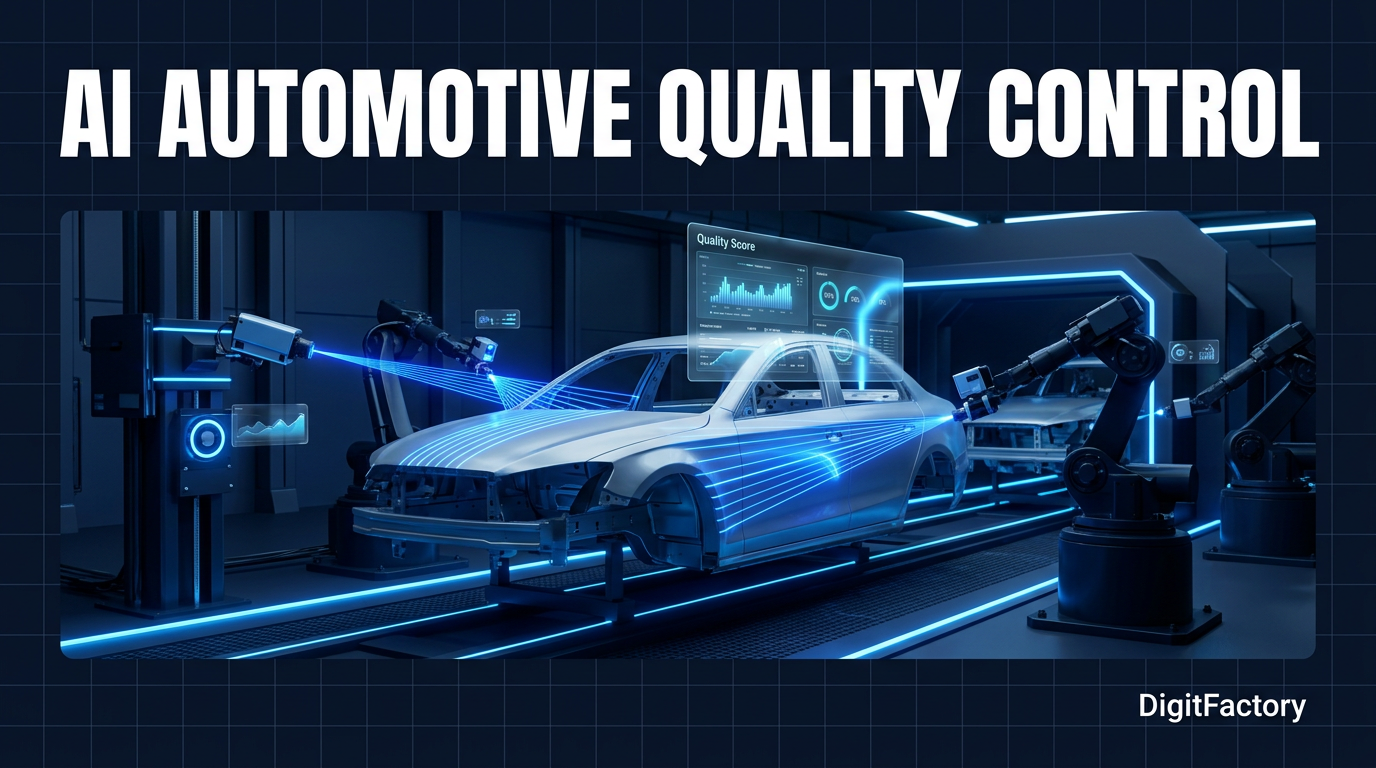
The automotive industry operates under some of the most demanding quality standards in all of manufacturing. A single undetected defect in a brake component, a structural weld, or an airbag housing can have life-threatening consequences. With vehicles containing over 30,000 individual parts and production lines running at cycle times measured in seconds, traditional manual inspection methods simply cannot keep pace with the precision and throughput that modern automotive manufacturing demands.
This is where AI automotive quality control enters the picture. By combining high-resolution industrial cameras with deep learning algorithms, automotive manufacturers are achieving what was previously impossible: 100% inline inspection at full production speed, with defect detection rates exceeding 99.5%. From paint surface analysis to weld integrity verification, AI-powered machine vision is becoming the backbone of zero defect manufacturing strategies across the global automotive supply chain.
The stakes are enormous. The average automotive recall costs manufacturers between $500 million and $1 billion, not counting reputational damage. Warranty claims related to quality defects drain billions annually from OEM profits. Against this backdrop, automotive visual inspection powered by artificial intelligence is not merely an operational improvement -- it is a strategic imperative for survival in an increasingly competitive market.
DigitFactory Automotive Expertise: DigitFactory combines 8+ years of industrial automation experience (PLC/SCADA) with cutting-edge AI vision technology to deliver automotive-grade quality control solutions. Our systems integrate seamlessly with existing production lines, delivering real-time OK/NOK decisions at speeds up to 60 frames per second on NVIDIA Jetson edge computing platforms.
AI Vision for Automotive Production Lines
Modern automotive production is a complex choreography of stamping, welding, painting, assembly, and testing. Each stage introduces potential quality risks that AI vision systems are uniquely positioned to address. Unlike human inspectors who fatigue after 20-30 minutes of concentrated visual work, machine vision automotive systems maintain consistent accuracy across three shifts, seven days a week.
Paint Surface Inspection
Automotive paint defects -- including orange peel texture, dust inclusions, runs, sags, craters, and color mismatches -- are among the most costly quality issues in vehicle manufacturing. A single repaint costs $800-$1,500 per vehicle, and paint defects account for up to 40% of all warranty claims in the body shop.
AI vision systems use multi-angle illumination combined with deep learning classifiers to detect paint anomalies as small as 0.3mm in diameter. The system categorizes defects by type and severity, enabling automated decisions about whether a panel requires spot repair, full repaint, or passes quality standards. Advanced systems can even predict paint defect patterns related to environmental conditions (humidity, temperature) or process drift in the spray booth.
Weld Quality Verification
A modern vehicle body contains between 4,000 and 5,000 spot welds, plus hundreds of MIG/MAG and laser welds. Each weld is a structural safety element. Traditional destructive testing (chisel tests, peel tests) can only sample a fraction of total production. AI-powered automotive visual inspection enables 100% non-destructive weld inspection by analyzing weld nugget appearance, spatter patterns, electrode indentation depth, and surface discoloration.
Machine learning models trained on thousands of weld images can distinguish between acceptable process variation and genuine defects such as cold welds, burn-through, insufficient nugget diameter, and electrode misalignment -- all in real time, without stopping the production line.
Assembly Verification
Final assembly involves hundreds of components that must be correctly positioned, torqued, and connected. AI vision systems verify clip presence, connector seating, label placement, fluid fill levels, and fastener engagement. Multi-camera setups can inspect an entire dashboard assembly in under 2 seconds, checking 50+ verification points simultaneously -- a task that would take a human inspector several minutes with significantly lower reliability.
Key Applications Across the Automotive Value Chain
The reach of AI automotive quality control extends across every major production area in vehicle manufacturing:
Body-in-White (BIW)
- Stamping defect detection: Identifying cracks, wrinkles, splits, and necking in pressed metal panels before they enter the body shop
- Dimensional verification: 3D vision systems measuring gap and flush tolerances between body panels to sub-millimeter accuracy
- Spot weld inspection: 100% inline verification of weld presence, position, and surface quality across all body joints
- Sealant application monitoring: Verifying continuous bead application for water tightness and corrosion protection
Powertrain Manufacturing
- Machined surface inspection: Detecting porosity, tool marks, and surface finish anomalies on engine blocks, cylinder heads, and transmission housings
- Gear and bearing inspection: Identifying micro-cracks, surface defects, and dimensional deviations in precision components
- Assembly completeness: Verifying O-ring presence, bolt torque markers, and correct component orientation in engine and transmission assembly
Interior and Exterior Components
- Trim and upholstery inspection: Detecting scratches, color variations, texture inconsistencies, and assembly gaps in instrument panels, door panels, and seating
- Lens and lighting inspection: Verifying optical clarity, color consistency, and defect-free surfaces on headlamps, tail lamps, and reflectors
- Chrome and decorative element verification: Inspecting plating quality, surface defects, and dimensional accuracy of badges, grilles, and trim pieces
Electronics and ADAS Components
- PCB inspection: Automated optical inspection (AOI) of solder joints, component placement, and circuit integrity for ECUs, sensors, and control modules
- Camera and sensor module testing: Verifying optical alignment, lens cleanliness, and image quality for ADAS cameras, LiDAR units, and parking sensors
- Wire harness verification: Confirming correct pin assignment, terminal crimping quality, and connector housing integrity
Compliance and Standards
The automotive industry operates within one of the most rigorous quality management frameworks in manufacturing. AI quality assurance systems must not only detect defects -- they must do so within a documented, validated, and auditable framework that satisfies multiple overlapping standards.
IATF 16949 Compliance
IATF 16949 is the international quality management standard for the automotive sector. AI vision systems support compliance by providing automated, repeatable inspection processes with full traceability. Every inspection result is logged with timestamp, part serial number, camera images, and classification decision -- creating an unbroken digital quality record that auditors require. The system's consistent performance eliminates the subjectivity that plagues manual inspection and directly supports the standard's emphasis on process capability and measurement system analysis (MSA).
VDA Standards
German VDA standards (Verband der Automobilindustrie) impose additional requirements for quality management, particularly around process audits (VDA 6.3) and product audits (VDA 6.5). AI vision systems provide the statistical data and process monitoring capabilities that VDA audits demand, including real-time SPC charts, Cpk calculations, and trend analysis that demonstrate sustained process capability.
PPAP and SPC Requirements
Production Part Approval Process (PPAP) submissions require evidence of process capability and measurement system adequacy. AI vision systems generate the data needed for Gage R&R studies, process capability indices, and control charts automatically. Statistical Process Control (SPC) is built into the system architecture, with automated alerts when processes drift toward control limits -- enabling intervention before defects occur rather than after.
"In automotive manufacturing, quality is not negotiable. AI vision systems provide the objective, repeatable, and fully traceable inspection capability that IATF 16949, VDA, and customer-specific requirements demand -- while operating at the speed and volume that modern production lines require."
ROI in Automotive Quality Control
The return on investment for AI automotive quality control is compelling across multiple dimensions. Automotive manufacturers implementing machine vision inspection systems typically see payback periods of 4-8 months, driven by measurable improvements in three key areas:
Scrap Reduction
Early defect detection prevents defective components from progressing through subsequent value-adding operations. A stamping defect caught immediately saves the cost of welding, painting, and assembling a part that will ultimately be scrapped. Automotive manufacturers report 40-60% scrap reduction after implementing AI vision at critical inspection points. For a typical body shop processing 1,000 bodies per day, this translates to annual savings of $2-5 million in material and rework costs alone.
Warranty Cost Reduction
Quality escapes that reach the customer are exponentially more expensive to resolve than defects caught in-plant. The rule of ten applies: a defect costing $1 to fix at the station costs $10 to fix at end-of-line, $100 at the dealer, and $1,000+ as a warranty claim. By catching defects at the source, AI vision systems drive 25-40% reductions in warranty costs within the first year. For OEMs with annual warranty reserves in the hundreds of millions, this represents a transformative financial impact.
Line Speed Improvement
Paradoxically, adding inspection capability can increase throughput. When quality is assured at each station, downstream rework loops are eliminated, stop-and-fix events decrease, and overall equipment effectiveness (OEE) improves. Manufacturers report 10-15% throughput improvements as quality-related line stoppages are reduced. AI vision also enables faster product changeovers, as inspection parameters can be updated in software rather than requiring physical gage changes.
Measurable Impact: Automotive manufacturers implementing DigitFactory AI vision solutions achieve 40-60% scrap reduction, 25-40% lower warranty costs, and 10-15% throughput improvement -- with typical ROI payback in under 6 months.
Summary: Driving Toward Zero Defects with AI
The automotive industry's pursuit of zero defect manufacturing is no longer an aspirational goal -- it is an achievable reality with AI-powered machine vision. From body-in-white welding to final assembly verification, AI automotive quality control delivers the precision, speed, and traceability that modern vehicle manufacturing demands. By aligning with IATF 16949, VDA, and PPAP requirements, these systems not only detect defects but integrate seamlessly into the quality management frameworks that govern the industry.
The financial case is equally compelling. With scrap reductions of 40-60%, warranty cost savings of 25-40%, and throughput improvements of 10-15%, AI vision systems represent one of the highest-ROI investments available to automotive manufacturers today. As vehicle complexity increases with electrification, autonomous driving features, and new materials, the role of intelligent visual inspection will only grow more critical.
DigitFactory's AI vision platform is purpose-built for the demands of automotive production. With edge computing on NVIDIA Jetson, real-time PLC/SCADA integration, and 100% product traceability, our solutions deliver automotive-grade quality assurance from day one.
Ready to achieve zero defect manufacturing? Explore how DigitFactory's AI-powered defect detection works in practice and discover how our solutions can transform your automotive quality control. Learn more about AI defect detection →
References
- IATF 16949:2016 — Quality management system requirements for automotive production and relevant service parts organizations. IATF. Available at: https://www.iatfglobaloversight.org/
- VDA Quality Standards — Verband der Automobilindustrie. Available at: https://www.vda.de/en
- Machine Vision in Automotive Manufacturing. Cognex. Available at: https://www.cognex.com/industries/automotive