AI Quality Control in Manufacturing: ROI Analysis and Implementation Guide
Poor quality is one of the most expensive problems in manufacturing. According to the American Society for Quality, the Cost of Poor Quality (COPQ) typically ranges from 1% to 5% of a manufacturer's total revenue. For a mid-size factory generating $50 million annually, that translates to $500,000 to $2.5 million lost every year to scrap, rework, warranty claims, and customer complaints. The challenge is clear: traditional manual inspection cannot keep pace with the speed, complexity, and precision demands of modern production lines.
Enter AI quality control — a technology that combines high-resolution cameras, edge computing, and deep learning models to inspect every single product in real time. Unlike human inspectors who fatigue after hours of repetitive work, AI systems deliver consistent, objective, and measurable results around the clock. But beyond the technical capabilities, the question every manufacturing leader asks is simple: What is the return on investment?
This guide breaks down the ROI of AI-powered quality control, explains how the technology works, and provides a practical roadmap for implementation.
The ROI of AI Quality Control
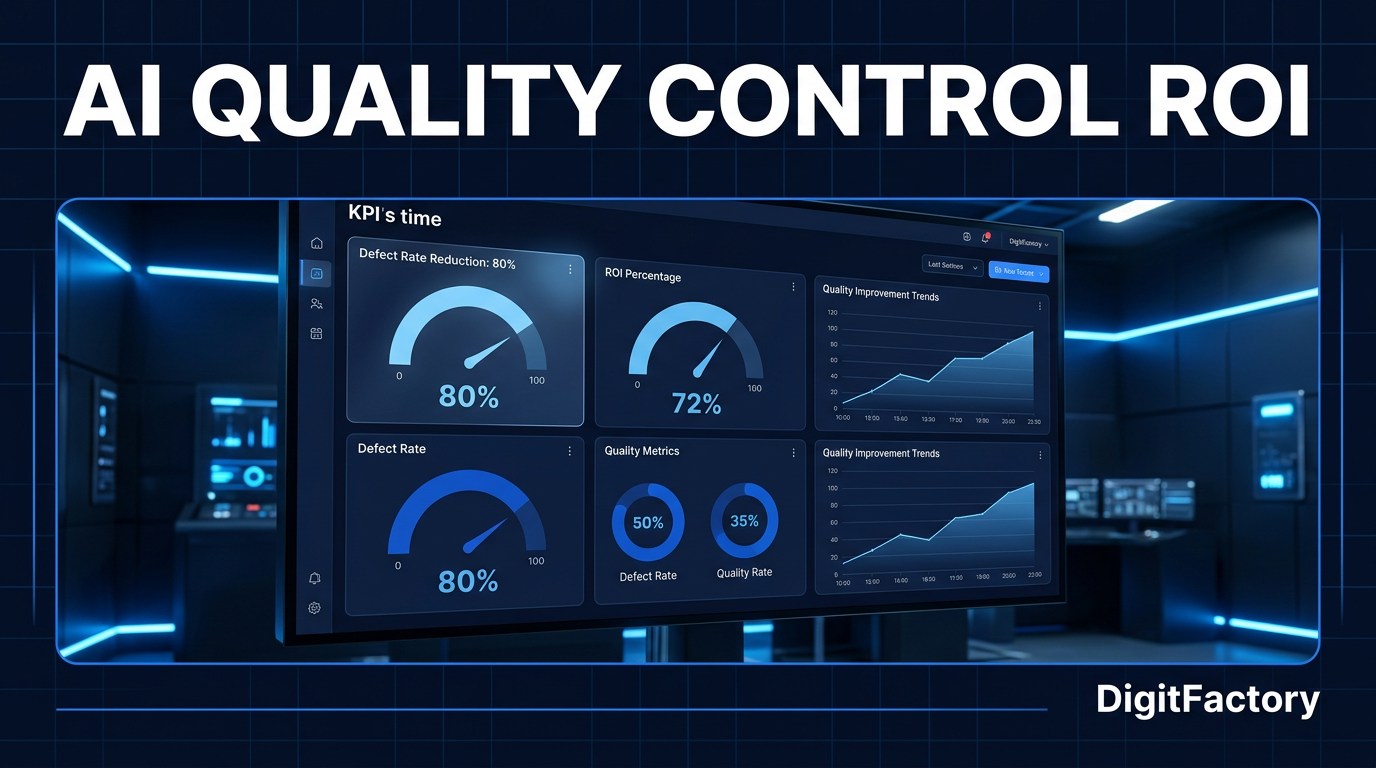
The financial case for AI quality control in manufacturing is compelling. Multiple industry studies and real-world deployments consistently show three core metrics that define the return:
Key ROI Metrics for AI Quality Control:
- 80%+ reduction in escaped defects — AI catches micro-defects (down to 0.25 mm) that human inspectors routinely miss, especially during night shifts or high-speed production runs.
- 40-60% reduction in scrap and rework costs — Early detection means defective parts are caught before value-adding operations are performed, saving material and labor.
- 3-6 month payback period — With typical system costs of $30,000-$80,000 per inspection station and savings of $200,000+ annually, payback is measured in months, not years.
Beyond direct cost savings, AI quality control delivers indirect financial benefits that compound over time:
- Reduced warranty claims: Fewer defective products reaching customers means fewer returns, replacements, and warranty repairs — often a 30-50% reduction in warranty costs within the first year.
- Lower insurance premiums: Documented quality improvement and full traceability can reduce product liability insurance costs.
- Customer retention: Consistent quality builds trust. Manufacturers who implement AI inspection report higher customer satisfaction scores and longer contract renewals.
- Regulatory compliance: In regulated industries (automotive, pharma, medical devices), automated inspection provides audit-ready documentation that reduces compliance costs.
"The biggest surprise was not the defect reduction — it was the ripple effect across the entire operation. Scrap went down, throughput went up, and our quality team could finally focus on root cause analysis instead of spending all day on the inspection line."
How AI Quality Control Works
An automated visual inspection system has three core components working together in real time:
1. Image Acquisition
High-resolution industrial cameras (2D and 3D) capture images of every product on the line. The camera setup is tailored to the application: line-scan cameras for continuous surfaces, area-scan cameras for discrete parts, and 3D sensors for geometry verification. Specialized lighting — diffuse, structured, or backlit — ensures that defects are visible regardless of surface finish or material type.
2. Edge AI Processing
Images are processed locally on edge computing platforms such as NVIDIA Jetson, which run trained deep learning models directly on the factory floor. This eliminates the need to send data to the cloud, providing inference speeds of under 50 milliseconds per frame and enabling real-time decisions at production speed. The models are trained on datasets containing thousands of images of both conforming (OK) and non-conforming (NOK) products, learning to recognize defect patterns with extraordinary accuracy.
3. Real-Time Classification and Action
Each inspected product receives an immediate OK/NOK classification. The system communicates directly with PLC controllers via industrial protocols (OPC-UA, Modbus, Profinet), triggering reject mechanisms, sorting stations, or line stops when critical defects are detected. Every inspection result — including images of detected defects — is archived for full traceability and statistical process control.
Manual vs. AI Inspection: A Comparison
Understanding the gap between traditional manual inspection and AI-powered defect detection is essential for building the business case:
- Detection accuracy: Manual inspection typically achieves 70-85% defect detection rates, varying with inspector fatigue and shift length. AI systems consistently deliver 95-99.5% detection rates, regardless of time of day or production volume.
- Inspection speed: A human inspector can review 20-40 parts per minute under ideal conditions. AI vision systems process 60+ frames per second, enabling 100% inline inspection at full production speed.
- Consistency: Human performance degrades over an 8-hour shift, with studies showing a 20-30% decline in detection rates after 4 hours. AI delivers identical performance in hour 1 and hour 24.
- Defect size limit: The human eye reliably detects defects above 0.5 mm. AI systems with proper optics detect defects down to 0.1-0.25 mm.
- Data and traceability: Manual inspection produces paper-based records or simple pass/fail counts. AI inspection generates rich data — images, measurements, trend analysis, and SPC charts — enabling continuous improvement.
- Cost per inspection: Manual inspection costs $15-25 per hour per inspector (plus benefits, training, and turnover costs). AI systems, after initial investment, operate at near-zero marginal cost per inspection.
The Bottom Line: AI inspection is not about replacing people — it is about elevating quality beyond what human-only inspection can achieve. The best implementations reassign quality staff to higher-value work: root cause analysis, process improvement, and supplier quality management.
Implementation Best Practices
Successful deployment of AI quality control follows a proven methodology. Here are the best practices drawn from real manufacturing implementations:
1. Start with a Focused Pilot
Do not attempt to deploy AI inspection across the entire factory at once. Select one production line or one product with a known quality problem. A focused pilot — typically 4-8 weeks — validates the technology on your specific products, with your specific defect types, in your specific environment. This approach minimizes risk and provides concrete data for the business case.
2. Define Clear KPIs Before You Start
Establish measurable success criteria before deployment. Common KPIs include:
- Defect escape rate (target: reduce by 80%+)
- False positive rate (target: below 2%)
- Scrap reduction (target: 40-60%)
- System uptime (target: 99%+)
- Payback period (target: under 6 months)
3. Invest in Data Collection and Labeling
The quality of your AI model depends entirely on the quality of your training data. Collect diverse samples of both good and defective products. Label defects by type, severity, and location. The more representative your dataset, the more robust your model will be in production. Plan for a minimum of 500-1,000 labeled images per defect category for initial training.
4. Choose the Right Hardware for Your Environment
Factory floors are harsh environments. Select cameras, lighting, and compute hardware rated for industrial conditions: temperature extremes, vibration, dust, and electromagnetic interference. Edge computing platforms like NVIDIA Jetson are designed for exactly these conditions, providing GPU-accelerated inference in a compact, rugged form factor.
5. Plan for Continuous Improvement
AI models are not static. Production changes, new products, and new defect types require ongoing model updates. Build a feedback loop where quality engineers can flag false positives and missed defects, which are then used to retrain and improve the model. The best systems get better over time, not worse.
Industry Applications
AI quality control is proving its value across a wide range of manufacturing sectors:
Automotive
Paint surface inspection, weld quality verification, assembly completeness checks, and dimensional measurement of engine components. Automotive manufacturers report 90%+ defect reduction and significant decreases in end-of-line rework.
Electronics
PCB solder joint inspection, component placement verification, connector pin alignment, and display panel defect detection. With component sizes shrinking below 0.5 mm, AI vision is often the only viable inspection method.
Pharmaceuticals
Tablet and capsule inspection, blister pack integrity, label verification, vial fill-level measurement, and particulate detection in liquids. AI inspection ensures GMP compliance while maintaining production throughput.
Food & Beverage
Foreign object detection, packaging seal integrity, label placement accuracy, fill-level verification, and color/texture analysis for freshness grading. AI systems inspect thousands of items per minute while meeting strict food safety standards.
Summary
AI quality control in manufacturing is no longer experimental — it is a proven technology with clear, measurable ROI. The numbers speak for themselves: 80%+ defect reduction, 40-60% scrap savings, and payback in 3-6 months. For manufacturers still relying on manual inspection, the cost of inaction grows every day as competitors gain quality advantages and customers raise their expectations.
The path forward is straightforward: start with a focused pilot, define your KPIs, and let the results guide your scale-up. The technology is mature, the hardware is industrial-grade, and the implementation methodology is proven.
Ready to see AI quality control in action? Explore how DigitFactory's AI-powered defect detection solution delivers measurable quality improvements on real production lines — with a success-fee model that aligns our incentives with your results.