Digital Twin and Predictive Maintenance: The Future of Smart Manufacturing
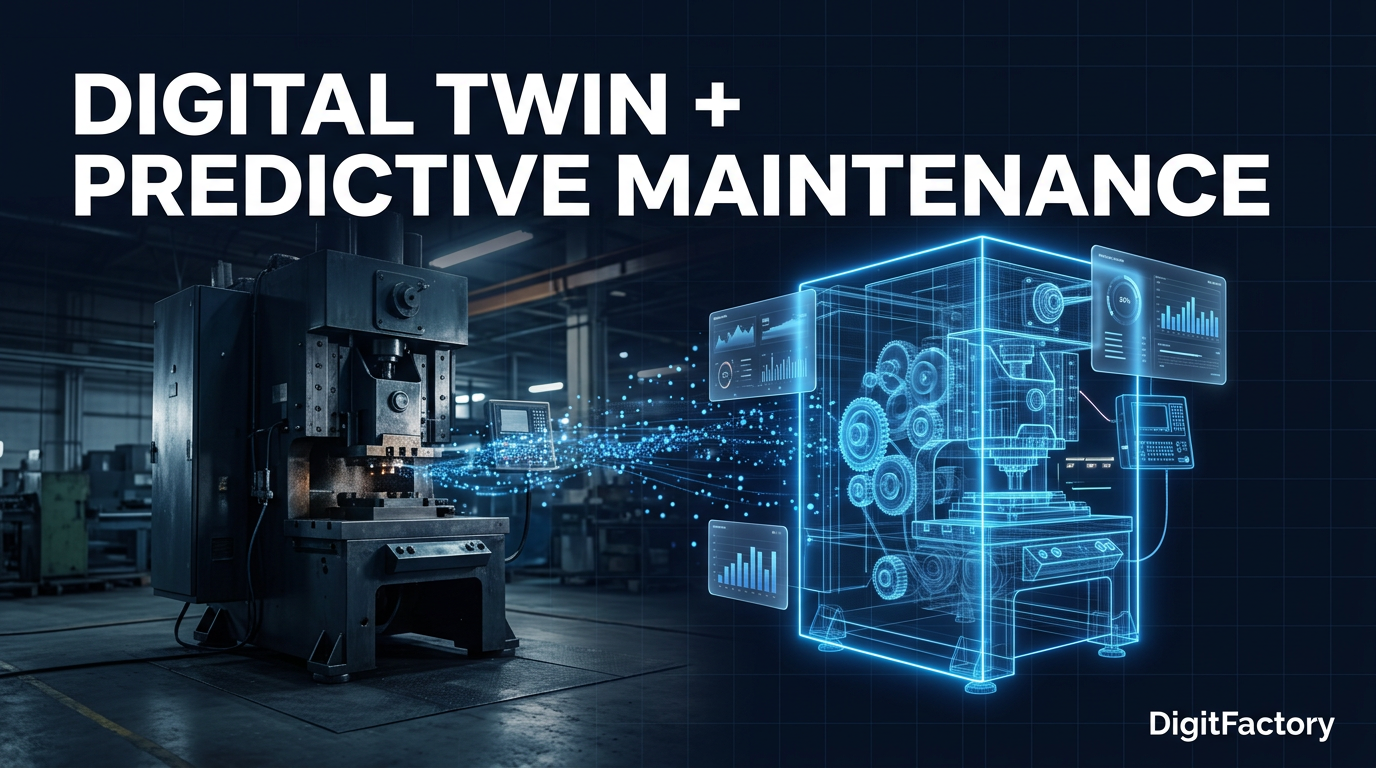
Manufacturing has always been a race against unplanned downtime. A single unexpected failure on a critical production line can cost tens of thousands of euros per hour in lost output, scrap, and emergency repairs. For decades, maintenance teams relied on fixed schedules or waited for something to break. Today, a powerful convergence of two technologies is rewriting those rules: the digital twin and predictive maintenance. Together, they give manufacturers the ability to see failures before they happen, test solutions in a virtual world, and act with surgical precision in the physical one.
This article explores how digital twin predictive maintenance works, why the combination is far more valuable than either technology alone, and how your factory can start benefiting from it today.
What Is a Digital Twin?
A digital twin is a real-time virtual replica of a physical asset, process, or entire production system. It is not a static 3D model or a simple dashboard. A true digital twin continuously ingests live data from sensors on the physical equipment, temperature probes, vibration monitors, motor current analyzers, flow meters, and updates its internal state to mirror reality at every moment.
The concept originated in aerospace, where NASA used virtual spacecraft models to simulate mission scenarios. Today, digital twin technology has matured to the point where it is practical and cost-effective for mainstream manufacturing. A digital twin of a CNC machine, for example, receives real-time spindle speed, tool wear measurements, coolant temperature, and axis positioning data. Its physics-based and data-driven models then calculate the machine's current health, predict how that health will evolve, and flag the moment when intervention becomes necessary.
Key distinction: A digital twin is not a one-time simulation. It is a living, continuously updated model that evolves alongside the physical asset it represents, making it uniquely suited for ongoing predictive maintenance.
Three characteristics define a mature digital twin:
- Real-time data synchronization: Sensor data flows continuously from the physical asset into the virtual model, keeping it aligned with actual operating conditions.
- Physics and AI models: The twin contains mathematical models, whether first-principles physics, machine learning, or both, that describe how the asset behaves under various conditions.
- Bidirectional feedback: Insights generated by the twin feed back into operational decisions, control parameters, and maintenance workflows in the real world.
Digital Twin + Predictive Maintenance: A Powerful Synergy
Predictive maintenance on its own uses sensor data and machine learning to forecast when a component will fail. This is already a significant improvement over reactive or calendar-based maintenance. But predictive maintenance alone answers only one question: "When will this part likely fail?"
A digital twin adds an entirely new dimension. It answers: "What happens if we change operating conditions? What if we delay maintenance by two weeks? What if we switch to a different supplier's bearing? What is the cascade effect on downstream equipment?"
When you combine digital twin technology with predictive maintenance, you unlock capabilities that neither can deliver alone:
- Failure simulation: Run accelerated degradation scenarios in the virtual model to understand how a developing fault will progress. Test whether reducing load by 10% extends bearing life enough to reach the next planned shutdown.
- Maintenance scenario testing: Before scheduling a repair, simulate the impact on production throughput, energy consumption, and quality. Choose the scenario that minimizes total cost, not just maintenance cost.
- Schedule optimization: Group maintenance activities across multiple assets by simulating their joint degradation trajectories. Find windows where maintaining three machines together saves more downtime than maintaining each separately.
- Root cause analysis: When a predictive model flags an anomaly, the digital twin helps isolate the root cause by simulating different fault modes and comparing their signatures against the observed data.
"Predictive maintenance tells you that a problem is coming. The digital twin tells you exactly what the problem is, how fast it will develop, and what the best response looks like. Together, they move you from prediction to prescription."
Key Benefits of Digital Twin Predictive Maintenance
Manufacturing leaders who deploy digital twin predictive maintenance consistently report measurable improvements across several dimensions:
1. Virtual testing before physical changes
Every change to a production process carries risk. Adjusting a setpoint, replacing a component with an alternative, or modifying a maintenance procedure can introduce unforeseen consequences. A digital twin lets you test these changes in the virtual environment first, eliminating trial-and-error on the production floor. This capability alone can save weeks of commissioning time and avoid costly quality incidents.
2. Predictive what-if scenarios
Traditional predictive maintenance gives you a single forecast: estimated time to failure. A digital twin lets you explore what-if scenarios. What if ambient temperature rises by 5 degrees during summer? What if production volume increases by 20% next quarter? By simulating these conditions, you can proactively adjust maintenance plans before problems materialize.
3. Reduced commissioning and startup time
When new equipment is installed or existing equipment is modified, the digital twin serves as a pre-commissioning testbed. Operators and engineers can validate control logic, test alarm thresholds, and rehearse startup procedures in the virtual environment. Plants that use digital twins for commissioning report 20-30% reductions in startup time and significantly fewer first-run issues.
4. Training without risk
Maintenance technicians can train on the digital twin, practicing diagnostic procedures, testing repair scenarios, and building experience with failure modes they may rarely encounter in real life. This is particularly valuable for complex equipment where mistakes during maintenance can cause secondary damage.
5. Extended asset lifespan
By continuously monitoring asset health and optimizing operating conditions through the digital twin, manufacturers can extend the useful life of critical equipment by 15-25%. The twin identifies operating regimes that minimize wear and degradation, balancing production demands against long-term asset preservation.
Architecture: From Sensor to Action
A digital twin predictive maintenance system follows a layered architecture that transforms raw sensor data into actionable maintenance decisions:
- Sensors and data acquisition: Vibration sensors, temperature probes, current transformers, pressure transducers, and other instruments capture the physical state of equipment. Industrial protocols (OPC UA, MQTT, Modbus) transport this data reliably.
- Edge computing: Edge devices, often GPU-accelerated platforms like NVIDIA Jetson, perform initial data processing, filtering, feature extraction, and anomaly detection close to the source. This reduces latency and bandwidth requirements.
- Digital twin model: The core virtual model runs in the cloud or on-premises, combining physics-based simulations with machine learning models trained on historical operational data. It maintains the real-time state of the asset and runs predictive algorithms continuously.
- AI prediction engine: Machine learning models, including time-series forecasting, survival analysis, and anomaly detection algorithms, analyze the twin's state to generate remaining useful life (RUL) estimates, failure probability scores, and maintenance recommendations.
- CMMS integration and action: Predictions flow into the Computerized Maintenance Management System (CMMS), automatically generating work orders, scheduling resources, ordering spare parts, and notifying the right personnel at the right time.
DigitFactory approach: DigitFactory's architecture connects PLC/SCADA systems at the shop floor level through edge AI processing to cloud-based digital twin models, providing end-to-end visibility from sensor to maintenance action. With 8 years of industrial automation experience, DigitFactory bridges the gap between OT and IT that often stalls digital twin projects.
Industry Applications
Digital twin predictive maintenance is delivering results across a wide range of manufacturing sectors:
- Automotive: OEMs use digital twins of press lines, paint shops, and assembly cells to predict tool wear, optimize cycle times, and schedule maintenance during model changeovers. Tier 1 suppliers apply the same approach to CNC machining centers and robotic welding cells.
- Pharmaceuticals: Batch process digital twins model reactor conditions, agitator performance, and filtration systems. Predictive maintenance ensures that critical equipment meets GMP compliance requirements, and virtual batch simulations validate that maintenance activities will not impact product quality.
- Energy and utilities: Power plants create digital twins of turbines, generators, and heat exchangers. These twins predict fouling, bearing degradation, and thermal stress, enabling maintenance during planned outages rather than forced shutdowns that cost millions per day.
- Heavy industry and metals: Steel mills and foundries use digital twins to monitor furnace linings, rolling mill bearings, and hydraulic systems operating in extreme conditions. The ability to simulate thermal and mechanical stress patterns extends campaign lengths and prevents catastrophic failures.
- Food and beverage: Digital twins of packaging lines, fillers, and sterilization equipment help maintain hygiene standards while minimizing unplanned stops. Predictive models account for product-specific fouling rates and cleaning cycle optimization.
Getting Started: A Practical Roadmap
Deploying digital twin predictive maintenance does not require a massive upfront investment or a multi-year transformation program. The most successful implementations follow an incremental approach:
Step 1: Start with a single critical asset
Identify the one machine or process that causes the most pain: the highest unplanned downtime, the most expensive repairs, or the greatest impact on production output. This becomes your pilot asset. A focused pilot delivers fast, visible results that build organizational confidence.
Step 2: Instrument and connect
Ensure the pilot asset has adequate sensor coverage. In many cases, existing PLC data and a few additional vibration or temperature sensors are sufficient. Connect this data to an edge processing layer that can handle real-time ingestion.
Step 3: Build the initial twin
Start with a data-driven model using 3-6 months of historical operational data. You do not need a perfect physics model from day one. Machine learning models trained on normal operating patterns can detect deviations and predict failures with high accuracy. Physics models can be layered in later to improve explainability and scenario simulation.
Step 4: Validate and iterate
Run the digital twin in shadow mode alongside existing maintenance practices. Compare its predictions against actual outcomes. Refine the models, adjust thresholds, and build trust with the maintenance team. This validation phase typically lasts 2-3 months.
Step 5: Scale across the plant
Once the pilot proves value, extend the approach to additional assets. Each new twin benefits from lessons learned and shared infrastructure. Over time, you can connect individual asset twins into a plant-level digital twin that optimizes maintenance across the entire facility.
"The biggest mistake companies make is trying to build a digital twin of their entire factory at once. Start small, prove value on one critical asset, and scale from there. A focused pilot can deliver ROI within 3-6 months."
Summary
Digital twin predictive maintenance represents the next evolution in how manufacturers care for their equipment. By combining a continuously updated virtual model with AI-driven failure prediction, manufacturers gain the ability to simulate, predict, and optimize maintenance like never before. The benefits are tangible: reduced unplanned downtime, lower maintenance costs, extended asset lifespans, faster commissioning, and safer training environments.
The technology is no longer reserved for aerospace giants or Fortune 500 companies. With modern edge computing, cloud platforms, and AI frameworks, digital twin predictive maintenance is accessible to mid-sized manufacturers who want to compete in the era of smart manufacturing.
Ready to explore digital twin predictive maintenance for your plant? DigitFactory specializes in connecting industrial equipment to AI-driven digital twins that deliver measurable results. Learn more about our predictive maintenance solutions and discover how a focused pilot can transform your maintenance operations.