Machine Condition Monitoring with AI: A Guide to Predictive Analytics in Manufacturing
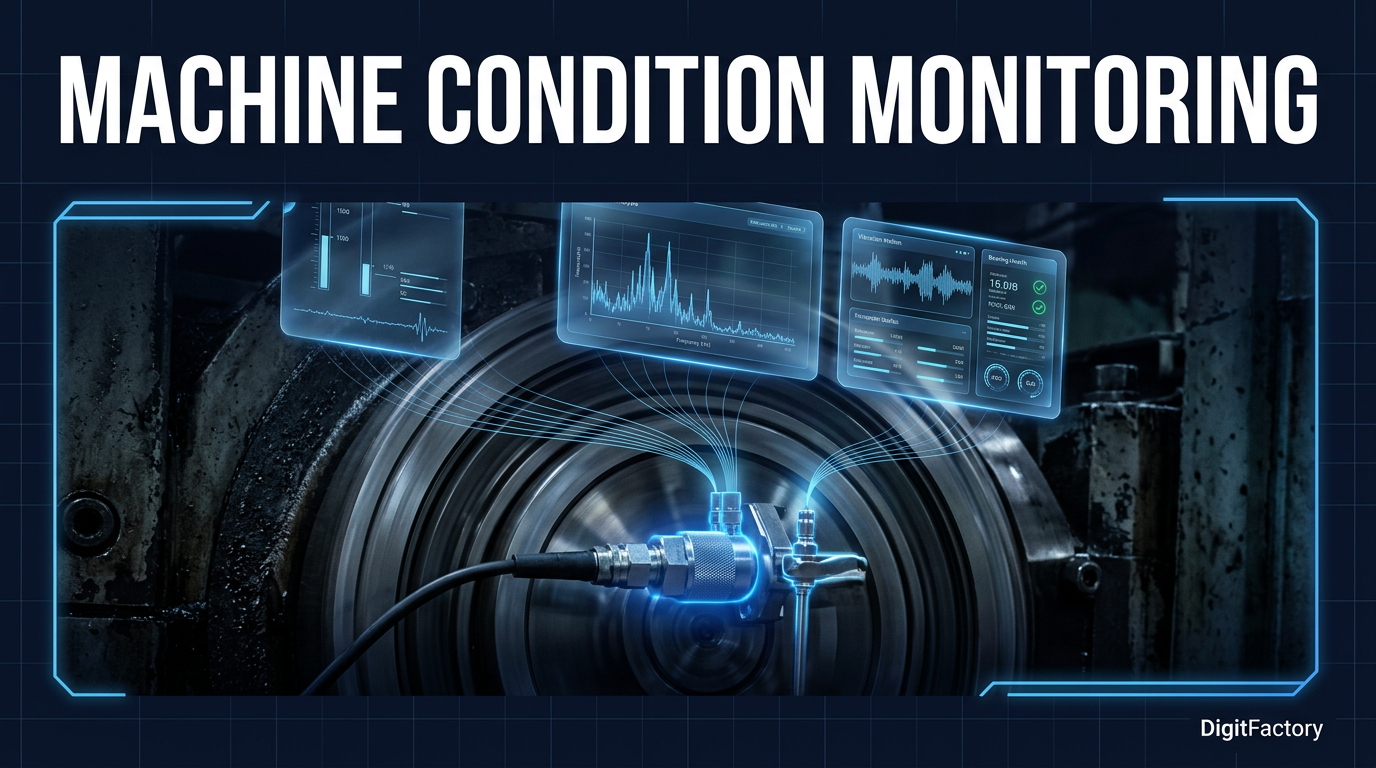
For decades, manufacturing maintenance relied on two approaches: running equipment until it failed, or performing periodic inspections on a fixed schedule. Both carry significant costs. Reactive maintenance leads to unplanned downtime that can cost large plants $50,000 or more per hour. Scheduled maintenance, while safer, often replaces parts that still have months of useful life remaining, wasting materials and labour.
Today, a third approach is reshaping the industry. Machine condition monitoring powered by artificial intelligence enables continuous, real-time assessment of equipment health. Instead of waiting for a breakdown or relying on calendar-based service intervals, AI systems listen to every vibration, measure every temperature shift, and analyse electrical signatures around the clock. The result is a maintenance strategy driven by actual equipment condition rather than guesswork.
This guide explains what condition monitoring is, how AI elevates it beyond traditional threshold-based methods, which technologies matter most, and how to implement a monitoring programme that integrates seamlessly with your existing industrial systems.
What is Condition Monitoring?
Condition monitoring is the process of continuously or periodically measuring specific parameters of a machine to detect changes that indicate developing faults. By tracking these parameters over time, maintenance teams can identify degradation long before it leads to a catastrophic failure.
The key parameters used in modern condition monitoring include:
- Vibration: The most widely used indicator of rotating equipment health. Changes in vibration amplitude, frequency, and pattern reveal imbalance, misalignment, bearing wear, gear damage, and looseness. Standards such as ISO 10816 and ISO 20816 define acceptable vibration levels for different machine classes.
- Temperature: Abnormal heat generation signals friction, electrical resistance, lubrication failure, or overloading. Infrared thermography and contact sensors provide continuous thermal profiles of motors, bearings, and electrical cabinets.
- Electrical current: Motor Current Signature Analysis (MCSA) detects rotor bar defects, stator winding issues, and mechanical load anomalies by examining the frequency spectrum of motor supply current.
- Acoustics and ultrasonics: High-frequency sound emissions reveal early-stage bearing defects, compressed air leaks, and electrical discharge (arcing) that are inaudible to the human ear.
- Oil and lubricant analysis: Particle counts, viscosity changes, and contamination levels in lubricating oil indicate wear rates and the condition of gears, bearings, and hydraulic systems.
Why it matters: Studies by the U.S. Department of Energy show that condition-based maintenance programmes can reduce maintenance costs by 25-30%, eliminate 70-75% of breakdowns, and cut downtime by 35-45% compared to reactive strategies.
AI-Powered vs Traditional Monitoring
Traditional condition monitoring relies on rule-based thresholds. An engineer sets a vibration alarm at, say, 7.1 mm/s RMS based on ISO 10816 for a Class II machine. If the reading crosses that threshold, an alert fires. While this approach catches obvious problems, it has fundamental limitations:
- Thresholds are static and cannot account for varying operating conditions such as load, speed, or ambient temperature.
- They miss slow degradation trends that have not yet crossed the alarm level but are clearly progressing toward failure.
- They generate false alarms during normal transient events like startup or load changes.
- They require expert manual configuration for every machine and every fault mode.
AI-powered condition monitoring replaces rigid thresholds with machine learning models that learn the normal operating signature of each individual machine. These models use techniques such as:
- Anomaly detection: Autoencoders and isolation forests learn the multidimensional envelope of normal behaviour. Any deviation, even a subtle one that no human-set threshold would catch, is flagged with a confidence score.
- Trend prediction: Recurrent neural networks (RNNs) and gradient-boosted models extrapolate degradation curves to estimate remaining useful life (RUL), giving maintenance teams weeks or months of advance warning.
- Fault classification: Convolutional neural networks (CNNs) trained on vibration spectrograms can distinguish between bearing inner-race defects, outer-race defects, misalignment, and imbalance, telling technicians not just that something is wrong, but exactly what is wrong.
- Context-aware baselines: Models adjust automatically for operating conditions. A pump running at 80% load is compared to its own 80%-load baseline, not to a generic threshold set for full-speed operation.
"The shift from threshold monitoring to AI-driven analytics is like moving from a smoke detector to a fire prediction system. You don't just know when the fire has started. You know where the wiring is overheating before it ignites."
Key Technologies
Vibration Analysis (ISO 10816 / ISO 20816)
Vibration analysis remains the cornerstone of machine condition monitoring. Modern systems use triaxial MEMS accelerometers and piezoelectric sensors capable of measuring frequencies from below 1 Hz to above 20 kHz. AI models process raw time-domain waveforms, compute FFT spectra, envelope spectra, and cepstrum analyses automatically, identifying bearing defect frequencies (BPFO, BPFI, BSF, FTF) without requiring a vibration analyst on staff.
Thermal Monitoring
Fixed-mount infrared cameras and distributed temperature sensors provide continuous thermal maps of critical equipment. AI algorithms detect hotspot trends, correlate temperature rises with load profiles, and differentiate between normal thermal cycling and abnormal heat accumulation. For electrical systems, thermal monitoring catches loose connections and overloaded circuits that are invisible to vibration sensors.
Motor Current Signature Analysis (MCSA)
MCSA is a non-invasive technique that analyses the stator current of electric motors to detect both electrical and mechanical faults. By examining sidebands around the supply frequency in the current spectrum, AI models identify broken rotor bars, air-gap eccentricity, bearing defects, and driven-load anomalies. The advantage of MCSA is that it requires no additional sensors, only a current transformer on the motor supply cable, making it one of the most cost-effective monitoring methods available.
Acoustic Emission and Ultrasonic Monitoring
Ultrasonic sensors operating in the 20-100 kHz range detect stress waves generated by microscopic surface defects in bearings and gears. These high-frequency emissions appear much earlier than changes in vibration amplitude, providing the earliest possible warning of developing faults. AI-powered acoustic systems filter ambient noise, identify fault-specific emission patterns, and track defect severity over time.
Integration with Industrial Systems
Condition monitoring delivers maximum value when it is tightly integrated with the existing plant control and management infrastructure. Isolated monitoring dashboards create information silos; integrated systems drive automated action.
- PLC integration: Monitoring systems communicate with Programmable Logic Controllers via OPC UA, Modbus TCP, or Profinet. When a critical anomaly is detected, the PLC can automatically reduce machine speed, switch to a backup unit, or initiate a controlled shutdown, preventing catastrophic failure before a human operator can respond.
- SCADA connectivity: Integration with Supervisory Control and Data Acquisition systems provides operators with a unified view of process variables and equipment health on a single screen. Historical trend overlays help correlate process upsets with equipment degradation events.
- CMMS work order automation: When the AI system predicts a bearing failure in 30 days, it can automatically generate a work order in the Computerised Maintenance Management System, assign the correct technician, reserve spare parts from inventory, and schedule the repair during a planned production window, all without manual intervention.
- Edge computing architecture: Platforms like NVIDIA Jetson enable AI inference directly at the machine, reducing latency to milliseconds and eliminating dependence on cloud connectivity. Only aggregated insights and alerts are sent upstream, minimising network bandwidth requirements.
DigitFactory approach: With deep expertise in PLC/SCADA systems and AI, DigitFactory bridges the gap between OT (operational technology) and modern data science. Our solutions connect directly to existing industrial protocols, ensuring that AI-driven insights translate into automated actions on the factory floor.
Monitored Equipment Types
AI-powered condition monitoring applies to virtually any rotating, reciprocating, or electrically driven equipment. The most common targets in manufacturing include:
- Electric motors: The workhorses of every factory. Monitoring covers bearing health, winding insulation, rotor condition, and alignment with driven equipment. Motors account for roughly 70% of industrial electricity consumption, making their efficient operation a priority.
- Pumps: Centrifugal, positive displacement, and submersible pumps are monitored for cavitation, seal wear, impeller damage, and bearing degradation. Pump failures are among the most common causes of unplanned downtime in process industries.
- Compressors: Screw, reciprocating, and centrifugal compressors require monitoring of valve condition, bearing health, intercooler performance, and capacity degradation. Air compressor systems can consume 20-30% of a plant's electrical energy.
- Gearboxes: Gear wear, tooth damage, and bearing faults are detected through vibration analysis and oil debris monitoring. Gearbox failures are costly due to long lead times for replacement components.
- CNC spindles: High-speed spindle bearings operate under extreme precision requirements. AI monitoring detects sub-micron changes in bearing preload, thermal growth, and tool-induced imbalance that affect part quality before they cause spindle failure.
- Conveyors: Belt conveyors, roller conveyors, and chain conveyors are monitored for bearing failures, belt misalignment, motor overloading, and gearbox degradation. In continuous production lines, a conveyor failure can halt the entire operation.
Implementation Guide
A successful condition monitoring programme follows a structured implementation path. Rushing to install sensors without proper planning leads to data overload and analyst fatigue. Here is a proven approach:
1. Criticality Assessment and Asset Selection
Begin by identifying the machines whose failure would have the greatest impact on production, safety, and cost. Use a criticality matrix that scores each asset on failure probability, consequence severity, and current maintenance cost. Focus the initial deployment on the top 10-20% of critical assets where monitoring delivers the highest return.
2. Sensor Selection and Installation
Choose sensors appropriate for each failure mode. Vibration sensors for rotating equipment, current transformers for motor health, temperature sensors for thermal monitoring. Wireless MEMS sensors have dramatically reduced installation costs, with battery-powered devices lasting 3-5 years and requiring no cabling. For critical machines, hardwired piezoelectric sensors provide continuous high-frequency data with no gaps.
3. Baseline Learning Period
Once sensors are installed, the AI system needs a learning period of 2-4 weeks (ideally longer) to establish the normal operating envelope for each machine under all its typical operating conditions. During this phase, the system observes vibration signatures at different loads, speeds, and temperatures, building a multidimensional model of healthy behaviour. This baseline is what makes anomaly detection possible.
4. Alert Configuration and Workflow Setup
Configure alert severity levels (information, warning, critical) with appropriate notification channels (dashboard, email, SMS, CMMS work order). Define escalation procedures: who gets notified, what response time is expected, and what automated actions the system should take. Start with conservative thresholds and refine based on operational experience to minimise false positives.
5. Continuous Improvement
Review AI model performance monthly. Feed confirmed fault diagnoses back into the training data to improve classification accuracy over time. Expand coverage to additional assets based on the results from the initial deployment. Track KPIs including mean time between failures (MTBF), unplanned downtime percentage, and maintenance cost per unit produced.
Summary
Machine condition monitoring with AI represents a fundamental shift in how manufacturers maintain their equipment. By moving from periodic checks and static thresholds to continuous, intelligent monitoring, companies gain the ability to predict failures weeks in advance, schedule maintenance during planned windows, and extend equipment life, all while reducing costs and improving safety.
The technology stack is mature and proven: MEMS vibration sensors, MCSA, thermal imaging, and edge AI processing on platforms like NVIDIA Jetson. The integration pathways with PLC, SCADA, and CMMS systems are well established. The remaining challenge is not technical but organisational: selecting the right assets, allowing proper baseline learning, and building the cross-functional collaboration between maintenance, operations, and data teams that makes predictive analytics actionable.
Ready to move from reactive to predictive? DigitFactory combines 8+ years of industrial automation expertise with cutting-edge AI to deliver condition monitoring solutions that integrate with your existing PLC/SCADA infrastructure. Explore our predictive maintenance platform to see how continuous AI monitoring can transform your maintenance strategy.
References
- ISO 10816-3:2009 - Mechanical vibration - Evaluation of machine vibration by measurements on non-rotating parts. International Organization for Standardization.
- Operations & Maintenance Best Practices Guide, Release 3.0. U.S. Department of Energy, Federal Energy Management Program (FEMP). Available at: https://www.energy.gov/femp/operations-maintenance-best-practices-guide
- Randall, R.B. Vibration-based Condition Monitoring: Industrial, Aerospace and Automotive Applications. John Wiley & Sons, 2011.