Machine Vision vs Manual Inspection: Why AI Quality Control Wins in Manufacturing
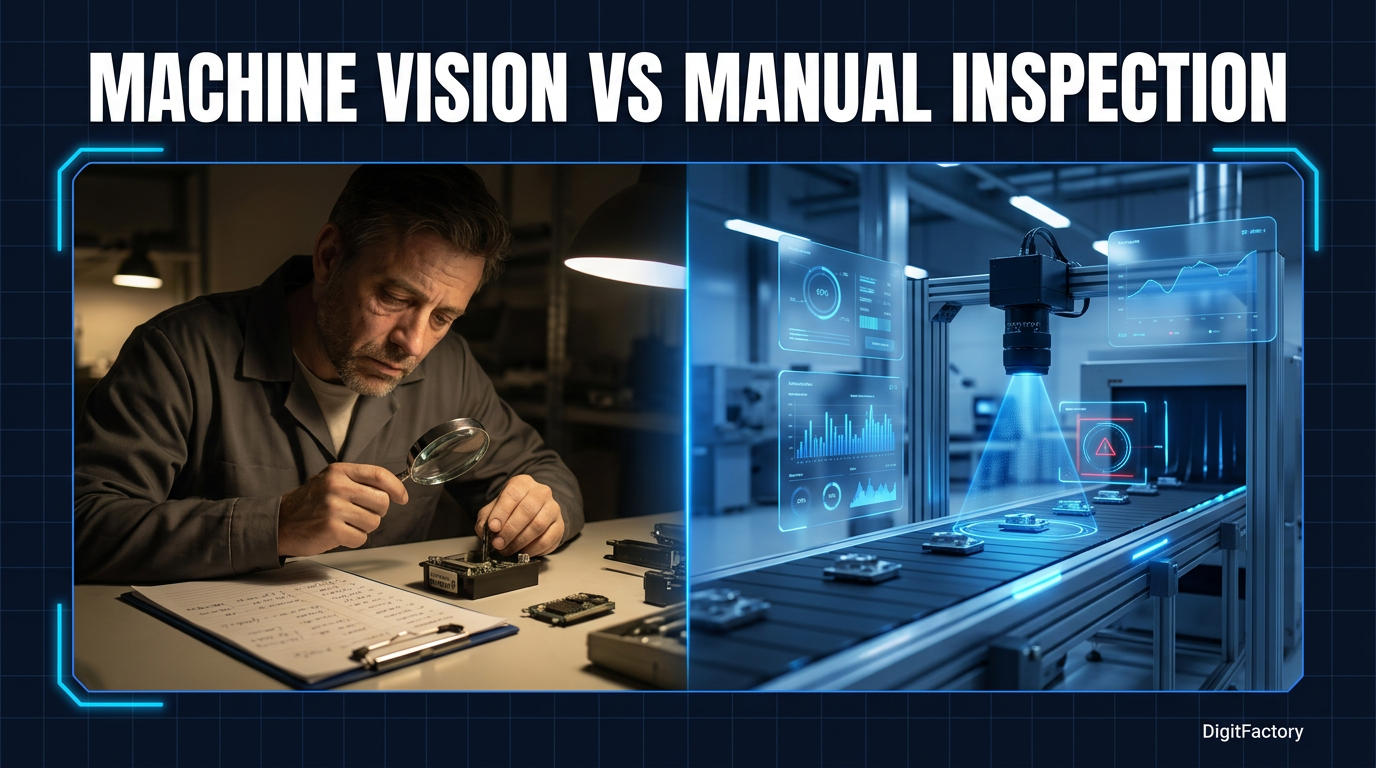
For decades, manufacturing quality control relied on one tool above all others: the human eye. Trained inspectors standing at the end of a production line, scanning every part for scratches, dents, misalignments, and color deviations. It worked, more or less. But as production speeds increase, tolerances tighten, and customer expectations rise, the gap between what manual inspection can deliver and what modern manufacturing demands is growing wider every year.
Enter machine vision quality control — a technology that combines industrial cameras, AI-powered image processing, and edge computing to inspect products in real time, at speeds and accuracy levels that human inspectors simply cannot match. The question is no longer whether machine vision will replace manual inspection, but how quickly manufacturers can make the transition.
In this article, we compare manual and automated inspection across every dimension that matters: speed, accuracy, cost, scalability, and consistency. We examine where manual inspection still has a role to play, and we look at the real-world results that manufacturers are achieving with AI-powered visual inspection today.
Manual Inspection: Limitations That Cost You Money
Manual visual inspection has been the default quality control method in manufacturing for over a century. An experienced inspector can identify many types of defects, apply contextual judgment, and adapt to new product variants without reprogramming. But these advantages come with serious, well-documented limitations.
Fatigue and inconsistency
Human attention is not constant. Studies in industrial ergonomics consistently show that inspector accuracy drops significantly after 20-30 minutes of continuous visual inspection. By the end of an 8-hour shift, detection rates can fall by 20-30% compared to the first hour. This is not a training problem — it is a fundamental limitation of human cognition.
Speed constraints
A skilled human inspector can examine roughly 1-2 parts per second for simple surface defects. For complex assemblies requiring multiple inspection points, throughput drops to seconds or even minutes per part. On high-speed production lines running at hundreds or thousands of parts per minute, 100% manual inspection is physically impossible.
Detection rate ceiling
Even under optimal conditions — good lighting, well-rested inspector, clear defect criteria — manual inspection typically achieves a detection rate of around 80%. That means 1 in 5 defective parts passes through undetected. For manufacturers with tight quality requirements or safety-critical products, this miss rate is unacceptable.
Subjectivity and variability
Two inspectors examining the same part may reach different conclusions. What one considers an acceptable cosmetic variation, another may flag as a defect. This inter-inspector variability makes quality metrics unreliable and creates inconsistencies between shifts, lines, and plants.
"We had three inspectors on rotation, and our defect escape rate varied by 15% depending on who was on shift. That variability was costing us more than the defects themselves — in rework, customer complaints, and lost trust."
— Production Manager, automotive parts manufacturer
Machine Vision: How It Works
Machine vision quality control replaces the human eye with a system of industrial cameras, specialized lighting, and AI algorithms running on edge computing hardware. Here is how the process works in practice:
Image acquisition
High-resolution industrial cameras — 2D or 3D depending on the application — capture images of every part on the production line. Specialized lighting (diffused, structured, backlighting) ensures that surface defects, dimensional deviations, and assembly errors are clearly visible regardless of ambient conditions.
AI-powered analysis
Captured images are processed by deep learning models trained on thousands of examples of both conforming and non-conforming parts. These models learn to detect scratches, cracks, discoloration, missing components, incorrect assembly, and dimensional deviations with sub-millimeter precision. Unlike rule-based systems, AI models improve over time as they are exposed to more data.
Edge computing for real-time decisions
Processing happens locally on edge devices such as NVIDIA Jetson platforms, not in a remote cloud. This eliminates latency and enables real-time pass/fail decisions at production line speed. A typical system can process 30-60 frames per second, inspecting every single part without slowing the line.
Integration with production systems
Machine vision systems communicate directly with PLC and SCADA systems. When a defect is detected, the system can automatically trigger rejection mechanisms, send alerts to operators, log the defect with a timestamped image, and update quality dashboards — all within milliseconds.
Head-to-Head Comparison: Machine Vision vs Manual Inspection
Let us compare the two approaches across the metrics that matter most to manufacturing operations:
Key comparison metrics:
- Detection accuracy: Manual: ~80% | Machine vision: 99.5%+
- Inspection speed: Manual: 1-2 parts/sec | Machine vision: 30-60 parts/sec
- Consistency: Manual: varies by shift, inspector, fatigue | Machine vision: identical performance 24/7
- Operating hours: Manual: 8-16 hours with breaks | Machine vision: 24/7/365
- Minimum defect size: Manual: ~0.5mm | Machine vision: 0.05mm+
- Data capture: Manual: limited paper records | Machine vision: 100% image archive + analytics
- Cost per inspection: Manual: increases with volume | Machine vision: decreases with volume
Speed
Machine vision systems inspect parts in under 0.1 seconds, enabling 100% inspection at full production speed. Manual inspection creates bottlenecks — either the line slows down for inspection, or only a sample is checked. Sampling-based quality control is a gamble: a 10% sample rate means 90% of defects could pass through undetected in any given batch.
Accuracy
AI-powered visual inspection systems achieve detection rates above 99.5%, compared to the 80% ceiling of manual inspection. More importantly, machine vision maintains this accuracy consistently — the first inspection of the day is identical to the ten-thousandth.
Cost
The initial investment in machine vision is higher than hiring inspectors. However, the total cost of ownership shifts dramatically over time. A machine vision system does not require salaries, benefits, training, or shift coverage. It does not call in sick. And as production volume increases, the cost per inspection drops toward zero, while manual inspection costs scale linearly with volume.
Scalability
Adding a second shift of manual inspectors doubles your labor cost. Scaling machine vision to handle higher volume often requires only a software configuration change. Deploying the same inspection model across multiple production lines or plants is a matter of replication, not recruitment.
When Manual Inspection Still Makes Sense
Machine vision is not the right answer for every situation. There are scenarios where human judgment remains valuable:
- Early-stage prototyping: When product specifications are still evolving and defect criteria are not yet defined, experienced inspectors provide the flexibility to make subjective quality assessments.
- Complex, one-off assessments: For custom or low-volume products where the cost of training an AI model exceeds the benefit, manual inspection may be more practical.
- Tactile and functional testing: Some quality checks require physical interaction — testing the feel of a surface, the force required to press a button, or the sound of a mechanism. These are beyond the scope of visual inspection.
- Regulatory environments requiring human sign-off: In some industries, regulations mandate that a human inspector physically signs off on quality checks, even when automated systems perform the primary inspection.
In practice, the most effective quality control strategies combine both: machine vision handles the high-speed, high-volume primary inspection, while human inspectors focus on edge cases, process improvement, and final verification.
Real-World Results
Manufacturers who have implemented automated quality inspection systems are seeing consistent, measurable improvements across their operations:
Proven performance metrics:
- 99.5% defect detection rate — versus ~80% with manual inspection
- <0.1 seconds per part — enabling 100% inspection at full line speed
- 24/7 continuous operation — no breaks, no shift changes, no fatigue
- 40-60% reduction in scrap — early defect detection prevents waste downstream
- 80%+ reduction in customer complaints — fewer defective products reach end customers
- 100% traceability — every part inspected, every defect documented with images
Beyond the numbers, manufacturers report a qualitative shift in how they think about quality. With complete inspection data and image archives, quality teams can identify root causes of defects, track trends over time, and implement targeted process improvements. Quality control evolves from a gate-keeping function into a continuous improvement engine.
Making the Transition: A Practical Approach
The shift from manual to machine vision manufacturing inspection does not have to be a big-bang replacement. The most successful implementations follow a phased approach:
1. Start with a pilot
Select one production line or one defect type for the initial deployment. This limits risk, provides a controlled environment for validation, and generates the data needed to build the business case for broader rollout.
2. Run in parallel
During the pilot phase, run machine vision alongside existing manual inspection. Compare detection rates, false positive rates, and throughput. This side-by-side comparison builds confidence and identifies any gaps that need to be addressed before full deployment.
3. Measure ROI early
Track concrete metrics from day one: defect detection rate, false positive rate, throughput impact, and labor reallocation. Most manufacturers see positive ROI within 3-6 months of deployment, driven by reduced scrap, fewer customer returns, and lower inspection labor costs.
4. Scale systematically
Once the pilot proves value, expand to additional lines, defect types, and plants. AI models trained on one line often transfer to similar lines with minimal retraining, accelerating deployment and reducing incremental costs.
"We started with one camera on one line. Within six months, we had the data to prove the ROI. Within a year, machine vision was deployed across all five production lines. The hardest part was not the technology — it was deciding to start."
— Plant Director, consumer electronics manufacturer
Summary
The comparison between machine vision and manual inspection is not close. On every metric that matters — speed, accuracy, consistency, scalability, and long-term cost — machine vision quality control delivers superior results. Manual inspection served manufacturing well for decades, but the demands of modern production have outpaced what human inspectors can reliably deliver.
The transition does not require a leap of faith. Start with a pilot, measure the results, and scale based on data. The technology is proven, the ROI is measurable, and the competitive advantage is real.
Ready to see machine vision in action? DigitFactory's AI-powered defect detection system delivers 99.5%+ accuracy, sub-second inspection times, and full traceability — with ROI in under 6 months. Explore our defect detection solution or schedule a demo to see how it works on your production line.