Predictive Maintenance in Manufacturing: A Complete Guide to AI-Powered Condition Monitoring
Unplanned downtime is the silent profit killer in manufacturing. When a critical motor, pump, or conveyor fails without warning, the consequences ripple through the entire operation: missed production targets, emergency repair costs, scrapped materials, and delayed customer orders. According to industry research, unplanned downtime costs industrial manufacturers an estimated $50 billion annually, with the average factory losing between 5% and 20% of its productive capacity to equipment failures.
Predictive maintenance in manufacturing offers a fundamentally different approach. Instead of waiting for machines to break (reactive maintenance) or servicing them on a fixed schedule regardless of actual condition (preventive maintenance), predictive maintenance uses real-time sensor data and machine learning models to forecast when equipment will fail — and intervene precisely when needed. The result: maintenance happens at the right time, every time.
DigitFactory combines 8 years of industrial automation experience (PLC, SCADA, S7, Modbus, OPC-UA) with modern AI to deliver predictive maintenance solutions purpose-built for manufacturing environments. Our platform, DigitFactory ONE, connects directly to your existing equipment and starts delivering actionable insights within weeks — not months.
How Predictive Maintenance Works
At its core, predictive maintenance is a data-driven process. It transforms raw machine signals into actionable maintenance decisions through four key stages:
1. Sensor Data Collection
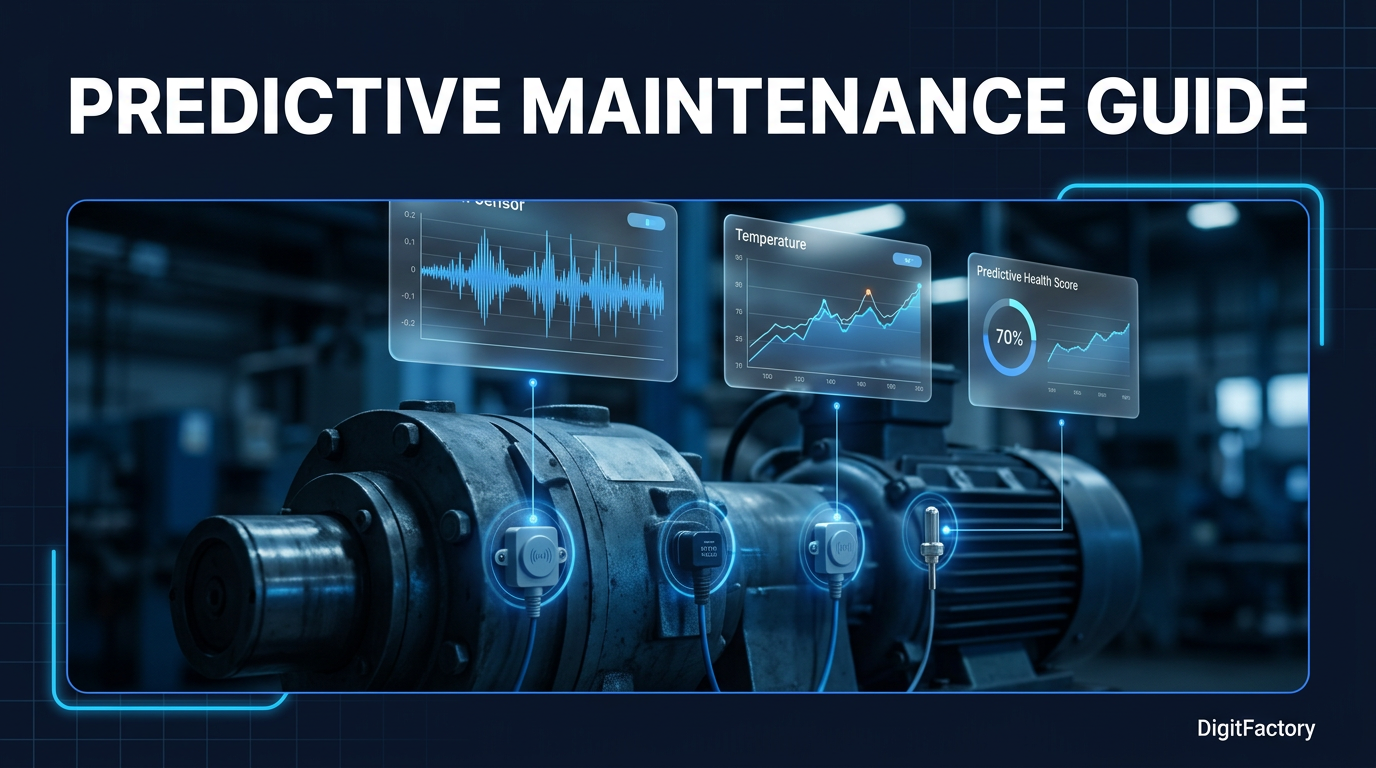
The foundation of any predictive maintenance system is continuous data collection from equipment. Industrial IoT sensors and existing machine instrumentation capture signals that reveal the health of critical assets:
- Vibration sensors — detect bearing wear, shaft misalignment, imbalance, and looseness in rotating equipment such as motors, pumps, and fans
- Temperature sensors — identify overheating in electrical components, friction buildup, and cooling system degradation
- Current and power sensors — reveal motor winding deterioration, load anomalies, and efficiency losses
- Pressure and flow sensors — monitor hydraulic and pneumatic systems for leaks, blockages, and valve degradation
- Acoustic and ultrasonic sensors — detect compressed air leaks, electrical arcing, and early-stage bearing failures inaudible to the human ear
In many cases, existing PLC and SCADA systems already collect much of this data. DigitFactory ONE connects to these systems via industrial protocols (S7, Modbus TCP/RTU, OPC-UA), meaning no expensive sensor retrofit is required to start.
2. Data Aggregation and Processing
Raw sensor readings are collected at high frequency — often hundreds or thousands of samples per second for vibration data. This data flows into a time-series database where it is cleaned, normalized, and enriched with contextual information such as production schedules, operating modes, and environmental conditions. Edge computing nodes handle initial processing close to the equipment, reducing latency and bandwidth requirements.
3. Machine Learning Analysis
This is where AI transforms data into foresight. Machine learning models trained on historical equipment data learn the "fingerprint" of normal operation for each asset. They then continuously compare incoming data against this baseline, detecting subtle deviations that indicate developing faults — often weeks or months before a human operator would notice anything wrong.
Common ML approaches include:
- Anomaly detection models — flag unusual patterns that deviate from learned normal behavior
- Remaining Useful Life (RUL) estimation — predict how many operating hours remain before a component needs replacement
- Classification models — identify the specific type of developing fault (e.g., outer race bearing defect vs. misalignment)
4. Alerts and Maintenance Orchestration
When the system detects a developing issue, it generates prioritized alerts with actionable context: which asset, what type of fault, estimated time to failure, and recommended action. Maintenance teams receive notifications through dashboards, email, or integration with existing CMMS (Computerized Maintenance Management Systems), enabling them to plan interventions during scheduled downtime windows.
"The best maintenance event is the one that never becomes an emergency. Predictive maintenance shifts the paradigm from firefighting to planning — and that changes everything about how a plant operates."
Key Benefits and ROI
The business case for predictive maintenance is backed by extensive industry data. Organizations that implement AI-powered condition monitoring consistently report:
- 25-30% reduction in maintenance costs — by eliminating unnecessary scheduled maintenance and reducing emergency repair expenses
- 45% reduction in unplanned downtime — by catching failures before they happen and scheduling repairs proactively
- 20-25% increase in equipment lifespan — by addressing root causes of wear early and avoiding cascading damage from undetected faults
- 10-15% improvement in OEE (Overall Equipment Effectiveness) — through higher availability and fewer quality issues caused by degrading equipment
- ROI within 6-12 months — pilot deployments typically demonstrate clear payback within the first year, with returns compounding as the system learns and coverage expands
Real-world impact: A McKinsey study found that predictive maintenance can reduce machine downtime by 30-50% and increase machine life by 20-40%. For a mid-size manufacturing plant, this translates to hundreds of thousands of euros in annual savings from a single production line.
Predictive vs. Preventive vs. Reactive Maintenance
Understanding the differences between maintenance strategies is crucial for making the right investment decision:
Reactive Maintenance (Run-to-Failure)
Equipment is used until it breaks, then repaired or replaced. While this minimizes upfront planning, it leads to the highest total cost: unplanned downtime, emergency parts procurement, overtime labor, secondary damage to connected equipment, and potential safety incidents. Suitable only for non-critical, easily replaceable assets.
Preventive Maintenance (Time-Based)
Maintenance is performed on a fixed schedule (e.g., every 3 months, every 1,000 operating hours) regardless of actual equipment condition. This reduces unexpected failures but leads to significant over-maintenance: parts are replaced too early, machines are stopped unnecessarily, and maintenance teams spend time servicing equipment that does not need attention. Studies show that up to 30% of preventive maintenance activities are performed too frequently.
Predictive Maintenance (Condition-Based)
Maintenance is triggered by actual equipment condition data analyzed by AI models. Interventions happen only when needed and with enough lead time for planned execution. This approach delivers the lowest total cost of ownership while maximizing equipment availability.
The key difference: Preventive maintenance asks "When was this machine last serviced?" Predictive maintenance asks "Does this machine actually need service right now?" That shift from calendar-based to condition-based decision-making is where the ROI comes from.
Industrial Protocols and Integration
One of the biggest barriers to adopting predictive maintenance in manufacturing is the perception that it requires replacing existing equipment or installing entirely new infrastructure. In reality, modern predictive maintenance platforms are designed to integrate with the systems already running on your factory floor.
DigitFactory ONE supports all major industrial communication protocols:
- Siemens S7 (S7comm / S7-1500) — direct read access to PLC data blocks, enabling condition monitoring of Siemens-controlled equipment without additional hardware
- Modbus TCP/RTU — the most widely deployed industrial protocol, supported by thousands of sensor and controller manufacturers
- OPC-UA — the modern, secure, platform-independent standard for industrial data exchange, providing structured access to machine data across vendor boundaries
- MQTT — lightweight messaging protocol ideal for edge-to-cloud communication in IIoT architectures
This protocol-native approach means DigitFactory ONE can read vibration, temperature, current, pressure, and operational data directly from your existing PLCs and SCADA systems — the same controllers that are already running your production lines. No production interruption is required for deployment.
Implementation: From Pilot to Scale
Successful predictive maintenance deployment follows a proven phased approach. DigitFactory has refined this methodology through hands-on experience in manufacturing environments:
Phase 1: Assessment and Pilot (2-4 weeks)
We start by identifying your most critical assets — the machines where unplanned downtime has the highest cost impact. A focused pilot on 3-5 assets demonstrates value quickly:
- Audit existing data sources (PLCs, SCADA historians, sensor infrastructure)
- Connect DigitFactory ONE to selected equipment via native industrial protocols
- Establish baseline operating profiles for each monitored asset
- Configure alerting thresholds and notification workflows
Phase 2: Model Training and Validation (4-8 weeks)
As the system collects operational data, ML models begin learning normal behavior patterns for each asset. Historical maintenance records and failure logs are incorporated to accelerate model training. Within weeks, the system starts identifying anomalies and generating its first predictive alerts.
Phase 3: Scale and Optimize (ongoing)
Once the pilot proves value on the initial asset set, coverage expands across the plant. Models continuously improve as they accumulate more data, and the system learns from every confirmed prediction — both correct alerts and missed events. Integration with CMMS and ERP systems automates work order creation and spare parts procurement.
"DigitFactory operates on a success-fee model: full payment only after achieving agreed KPIs. We take on the risk because we are confident in the results our platform delivers in real factory environments."
Summary: The Future of Maintenance is Predictive
The manufacturing industry is at an inflection point. Rising equipment complexity, tighter margins, and increasing customer expectations for on-time delivery make unplanned downtime less tolerable than ever. Predictive maintenance powered by AI and industrial IoT is no longer experimental — it is a proven strategy delivering measurable ROI across industries, from automotive and metals processing to food and beverage, pharmaceuticals, and discrete manufacturing.
The manufacturers who adopt condition-based monitoring today will build a compounding advantage: lower costs, higher uptime, longer equipment life, and the operational resilience to compete in increasingly demanding markets.
Ready to eliminate unplanned downtime? Learn how DigitFactory ONE delivers AI-powered predictive maintenance for your production equipment. Explore our Predictive Maintenance solution →
References
- McKinsey & Company. "Maintenance 4.0 — Implementation is key." Available at: mckinsey.com
- Deloitte. "Predictive Maintenance and the Smart Factory." Available at: deloitte.com
- U.S. Department of Energy. "Operations & Maintenance Best Practices Guide." Available at: energy.gov