Predictive Maintenance ROI: Cost Analysis and Business Case for Manufacturing
The decision to invest in predictive maintenance (PdM) ultimately comes down to business economics. Plant managers and operations directors in manufacturing face the constant challenge of allocating limited budgets for maximum impact. The promise of fewer breakdowns alone is not enough — what is needed is a robust ROI calculation that transparently presents the concrete financial benefits against the investment costs.
In this article, we analyze the cost structure of industrial maintenance, present a practical ROI calculation with real numbers, and compare the economics of different maintenance strategies. The goal: a solid decision-making foundation for your investment in predictive maintenance.
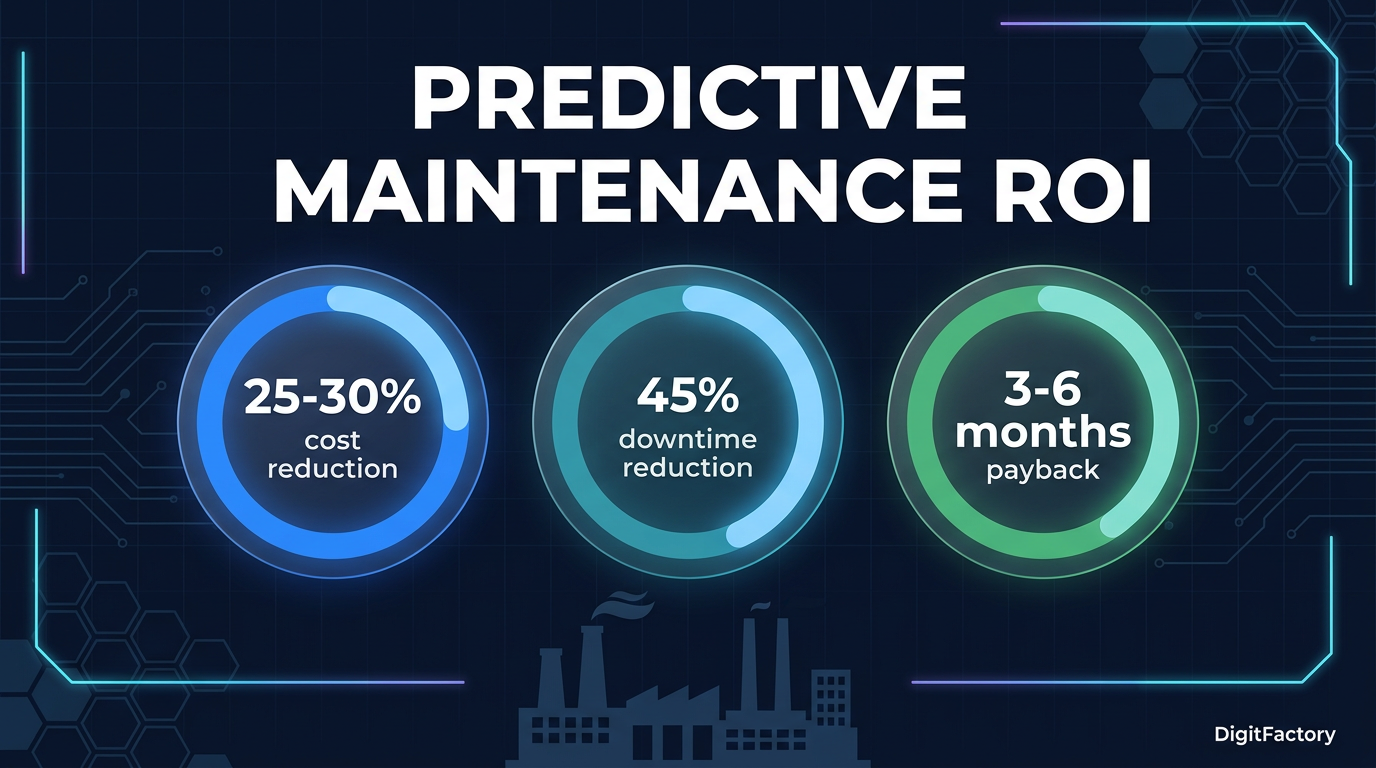
DigitFactory combines deep expertise in industrial automation (PLC/SCADA) with cutting-edge AI technology. Our predictive maintenance solutions based on Edge AI and NVIDIA Jetson deliver measurable savings — typically paying for themselves within 3 to 6 months.
Understanding Maintenance Cost Structure
To correctly calculate the ROI of predictive maintenance, you first need to understand the full scope of maintenance costs. These break down into four main categories:
- Labor costs (30-40% of total costs): Maintenance technician wages, overtime premiums for emergency repairs, training costs, and external contractors. Unplanned breakdowns often require weekend and night shifts, increasing labor costs by 50-100%.
- Spare parts and materials (20-25%): Parts inventory holding costs, express shipping for unplanned failures, and costs of damaged components from cascading failures. A bearing failure that goes undetected can destroy an entire gearbox — instead of replacing a bearing worth 200 euros, you end up replacing a gearbox worth 15,000 euros.
- Downtime costs (25-35%): The largest and most frequently underestimated cost driver. Production losses, delivery delays, contractual penalties, and customer attrition. In the automotive industry, one minute of unplanned downtime costs an average of 22,000 euros. Even in mid-sized operations, costs range from 5,000 to 15,000 euros per hour.
- Energy costs (10-15%): Machines running in suboptimal condition consume significantly more energy. A worn bearing increases motor energy consumption by 5-15%. A misaligned drive can raise power consumption by up to 20%. With rising energy prices, this is an increasingly critical factor.
In a typical mid-sized manufacturing facility, annual maintenance costs amount to 3-5% of total asset value. For a machine park worth 10 million euros, that translates to 300,000 to 500,000 euros per year — a substantial optimization opportunity.
ROI Calculation: Formula and Real-World Example
The basic formula for predictive maintenance Return on Investment is:
ROI = (Annual Savings - Annual Investment Cost) / Annual Investment Cost x 100%
Real-world example: Mid-sized automotive supplier
An automotive supplier with 3 production lines and 45 critical machines invests in a predictive maintenance system:
Investment costs (Year 1):
- Sensors and edge hardware (NVIDIA Jetson): 25,000 euros
- Software license and AI model development: 15,000 euros
- Integration with existing PLC/SCADA systems: 7,000 euros
- Maintenance team training: 3,000 euros
- Total investment: 50,000 euros
Annual savings:
- Reduction of unplanned downtime (45% less): 75,000 euros
- Lower spare parts costs (preventing cascading failures): 30,000 euros
- Reduced overtime and emergency call-outs: 20,000 euros
- Energy savings from optimized machine condition: 15,000 euros
- Extended machine lifespan (10-20%): 10,000 euros
- Total annual savings: 150,000 euros
First-year ROI:
ROI = (150,000 - 50,000) / 50,000 x 100% = 200%
From the second year onward, investment costs drop to approximately 12,000 euros annually (maintenance, updates, sensor replacement), while savings remain stable or even increase as AI models become more accurate with additional data.
Savings Breakdown in Detail
The measurable benefits of predictive maintenance can be summarized in concrete KPIs, supported by studies from McKinsey, Deloitte, and the U.S. Department of Energy:
- 25-30% reduction in maintenance costs: By shifting from time-based to condition-based maintenance, unnecessary service interventions are eliminated. Components are replaced exactly when their condition requires it — not too early (waste) and not too late (failure).
- 45% reduction in unplanned downtime: Early warning systems detect anomalies days or weeks before a failure occurs. The maintenance team can schedule the repair during planned shutdowns instead of scrambling in emergency mode.
- 10-20% extension of machine lifespan: Machines consistently kept in optimal operating condition wear more slowly. Continuous condition monitoring prevents operation under boundary conditions that lead to accelerated aging.
- 10-15% energy savings: Worn components and misalignments significantly increase energy consumption. Predictive maintenance identifies these inefficiencies early and enables targeted corrections.
- 70-75% fewer safety incidents: Machine breakdowns are a frequent cause of workplace accidents. Early detection of critical conditions prevents dangerous situations before they occur.
"Predictive maintenance transforms maintenance from a cost center into a strategic competitive advantage. Those who truly know their machines control their production."
Comparing Maintenance Strategies
To put the economics of predictive maintenance in perspective, it is worth comparing the three fundamental maintenance strategies:
1. Reactive maintenance (run-to-failure)
Machines are only repaired when they break down. At first glance it appears to be the cheapest approach — in practice, it is the most expensive strategy. Unplanned downtime, cascading damage, express deliveries, and overtime push the Total Cost of Ownership (TCO) 40-60% above planned maintenance costs. Typical costs: 15-18 euros per HP per year (benchmark from the U.S. Department of Energy study).
2. Preventive maintenance (time-based)
Maintenance on a fixed schedule — regardless of actual machine condition. Reduces unplanned failures by approximately 25% compared to reactive maintenance, but leads to unnecessary service work. Up to 30% of preventive maintenance activities are performed on components that are still functioning perfectly. Typical costs: 11-13 euros per HP per year.
3. Predictive maintenance (condition-based)
Maintenance precisely when sensor data and AI models detect impending wear. Combines the best of both worlds: minimal unplanned failures with optimized maintenance effort. Lowest TCO of all three strategies. Typical costs: 7-9 euros per HP per year — a reduction of 40-50% compared to reactive maintenance.
Payback Period
The typical payback period for a predictive maintenance investment is 3 to 6 months. This comparatively short timeframe is explained by the immediate impact on downtime costs, which represent the single largest item in maintenance expenditure.
Factors that influence the payback period:
- Asset criticality: The higher the downtime cost per hour, the faster the payback. In the automotive industry, the investment can pay for itself by preventing a single unplanned stoppage.
- Number of monitored machines: Economies of scale reduce the cost per machine. Above 20 monitored assets, the average cost per measurement point drops significantly.
- Existing infrastructure: If sensors or PLC/SCADA systems are already in place, the initial investment is considerably reduced. DigitFactory solutions integrate seamlessly with existing automation infrastructure.
- Industry-specific requirements: Regulated industries (pharma, food) gain additional value from comprehensive documentation and compliance evidence.
- Data quality and model maturity: AI models become more accurate with growing data volumes. After a 3-6 month learning phase, prediction accuracy typically exceeds 95%.
Practical Examples Across Industries
Automotive supplier: Stamping plant with 12 presses
A mid-sized automotive supplier installed vibration sensors and current monitoring on 12 stamping presses. Within the first 4 months, the system detected an incipient bearing defect on a critical press — 3 weeks before the projected failure. The planned replacement during a weekend cost 2,800 euros. An unplanned failure would have shut down the production line for at least 18 hours, with estimated costs of 180,000 euros (downtime + contractual penalties + emergency repair). The 35,000-euro investment had already paid for itself more than five times over with this single prevented failure.
Food production: Refrigeration and filling systems
A food manufacturer implemented predictive maintenance on compressors and filling lines. Continuous temperature monitoring of refrigeration units and vibration analysis of the filling line resulted in a 52% reduction in unplanned downtime in the first year. Additionally, compressor energy consumption dropped by 12%, as inefficient operating conditions were detected and corrected early. Total savings amounted to 120,000 euros on a 42,000-euro investment.
Pharmaceutical production: Cleanroom manufacturing
In pharmaceutical production, a machine breakdown has particularly severe consequences: interrupted batches often must be entirely discarded, and recommissioning requires extensive requalification. A pharmaceutical company deployed predictive maintenance on critical cleanroom equipment. The batch rejection rate decreased by 35%, as temperature- and vibration-critical deviations were identified early. Annual savings from prevented batch losses alone amounted to 280,000 euros.
Summary: Predictive Maintenance as a Strategic Investment
The numbers speak for themselves: predictive maintenance is not an experimental technology but a sound business investment with proven ROI. With typical payback periods of 3 to 6 months, cost reductions of 25-30%, and a 45% decrease in unplanned downtime, predictive maintenance delivers a compelling cost-benefit ratio — across industries from automotive suppliers to pharmaceutical manufacturers.
Getting started does not require a large-scale project. A focused pilot on a critical asset delivers measurable results within a few weeks and creates the data foundation for a step-by-step rollout across the entire machine park.
Calculate your savings potential: DigitFactory offers a personalized ROI analysis for your machine park. Our predictive maintenance solutions based on Edge AI and NVIDIA Jetson integrate seamlessly with your existing PLC/SCADA infrastructure. Contact us for a free consultation.
References
- Operations & Maintenance Best Practices Guide. U.S. Department of Energy. Available at: https://www.energy.gov/femp/operations-maintenance-best-practices-guide
- Predictive Maintenance: Taking proactive measures based on advanced data analytics. Deloitte Analytics Institute. Available at: https://www2.deloitte.com/us/en/pages/manufacturing/articles/predictive-maintenance-in-manufacturing.html
- Manufacturing Analytics: Unlocking the potential of Industry 4.0. McKinsey & Company. Available at: https://www.mckinsey.com/capabilities/operations/our-insights/manufacturing-analytics-unleashes-productivity-and-profitability